Hypercholesterolaemia in Ireland:
An estimated 1 in 2 Irish adults has elevated cholesterol — and most have no idea. Known as a "silent killer," high cholesterol causes no symptoms yet silently damages arteries for decades, dramatically raising the risk of heart attack and stroke. This guide covers everything you need to know: causes, warning signs, treatments, prevention, and the research that is reshaping cardiovascular care.
Cardiovascular disease is the leading cause of death in Ireland. And one of its most powerful drivers — elevated blood cholesterol — affects approximately half of all Irish adults, the vast majority of whom are unaware of it. Hypercholesterolaemia is, by its very nature, a condition that announces itself not with symptoms, but with events: a heart attack, a stroke, a sudden cardiac death.
The extraordinary challenge of high cholesterol is precisely this silence. Unlike diabetes, which may cause fatigue or thirst, or hypertension, which occasionally causes headaches, hypercholesterolaemia causes nothing that you can feel — until it has spent years narrowing the arteries that supply your heart and brain. By the time it declares itself, the damage is often already done.
The good news is equally significant: hypercholesterolaemia is one of the most treatable conditions in all of medicine. The cholesterol-lowering therapies available today — from long-established statins to the newest RNA-based medicines — are among the best-evidenced interventions in modern pharmacology. And they work best when started early, before damage accumulates. Detection, through a simple blood test, is everything.
Section 01
High Cholesterol in Ireland: Understanding the Scale
Cholesterol is a waxy, fat-like substance produced naturally by the liver and obtained through diet. It is essential for building cell membranes, producing hormones and synthesising vitamin D. The problem arises when levels — particularly of low-density lipoprotein (LDL) cholesterol — rise above a threshold at which arterial damage begins to occur. This process, atherosclerosis, is the foundation of most heart attacks and strokes.
Data from the Irish Heart Foundation and the Irish Longitudinal Study on Ageing (TILDA) at Trinity College Dublin paint a sobering picture of cholesterol prevalence in Ireland. TILDA wave data consistently show that elevated total cholesterol is one of the most common unmanaged cardiovascular risk factors among adults over 50. Meanwhile, the HSE estimates that cardiovascular disease — to which hypercholesterolaemia makes a major contribution — costs Ireland in excess of €2 billion annually.
Source: Irish Heart Foundation; TILDA Wave 6 Report; HSE National Clinical Programme for Cardiovascular Disease; FH Ireland.
Familial hypercholesterolaemia (FH) deserves particular attention. This inherited genetic condition — affecting approximately 1 in 250 people, or an estimated 20,000 individuals in Ireland — causes dramatically elevated LDL cholesterol from birth, placing those affected at risk of heart attack often decades before they would otherwise be expected. The FH Ireland advocacy group estimates that over 90% of FH cases in Ireland remain undiagnosed. Without treatment, men with FH have a 50% risk of a coronary event before age 50; women before age 60.
Section 02
Types of Hypercholesterolaemia
Not all elevated cholesterol has the same cause or the same clinical implication. Understanding the type and pattern of your lipid abnormality guides treatment decisions.
Section 03
Causes and Risk Factors
Genetic Causes
Familial hypercholesterolaemia is the most important genetic cause of premature cardiovascular disease. It results primarily from mutations in the gene encoding the LDL receptor — the cellular mechanism by which LDL cholesterol is cleared from the bloodstream. When LDL receptors are absent or deficient, LDL accumulates in the blood and deposits progressively in arterial walls. The condition is autosomal dominant, meaning that only one copy of the affected gene is sufficient to cause it. Children of an affected parent have a 50% chance of inheriting it.
Lifestyle and Environmental Causes
For most people, high cholesterol is a product of the intersection between genetic predisposition and lifestyle. The following risk factors are each independently associated with elevated LDL or total cholesterol, and their combination substantially amplifies risk.
Section 04
Signs and Symptoms
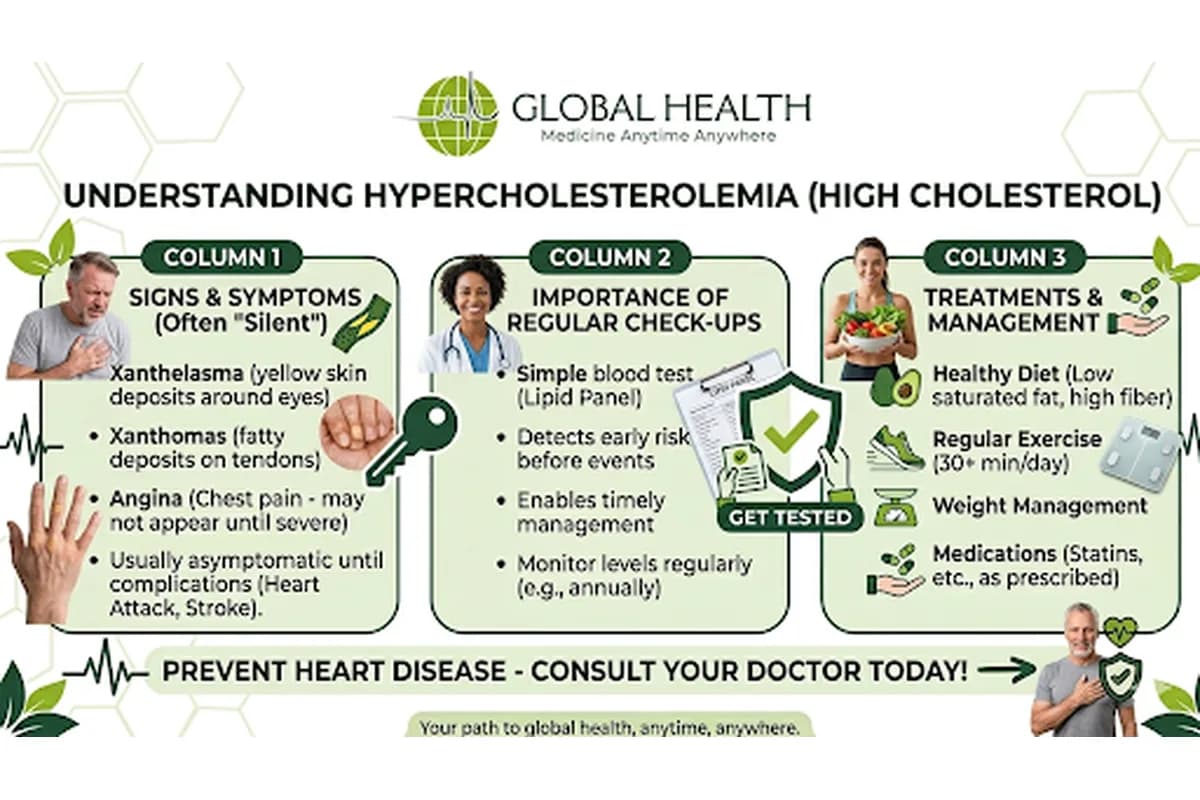
This is the defining clinical challenge of hypercholesterolaemia: it is almost entirely asymptomatic until significant arterial damage has occurred. There are no pain signals, no fevers, no breathlessness caused by cholesterol alone. The first "symptom" for many patients is a heart attack or stroke — often in a person who felt entirely well the day before.
In cases of severe or long-standing elevation — particularly in familial hypercholesterolaemia — certain physical signs may appear. These are important to recognise, as they are often the only visible clues that a significant lipid abnormality is present:
The key clinical message is unambiguous: do not wait for symptoms. A fasting lipid panel blood test is the only reliable method to detect elevated cholesterol. It is simple, inexpensive and widely available through your GP. The absence of symptoms is not reassurance — it is precisely when action is most needed.
Section 05
Current Treatments for Hypercholesterolaemia in Ireland
The treatment of hypercholesterolaemia in Ireland follows the Irish Heart Foundation guidelines, the European Society of Cardiology (ESC) / European Atherosclerosis Society (EAS) Guidelines for Dyslipidaemias (most recently updated in 2024), and the HSE National Clinical Programme for Cardiovascular Disease. The goal of treatment is defined not by a single cholesterol number, but by a target LDL level determined by individual cardiovascular risk — with higher-risk patients requiring more aggressive LDL reduction.
Treatment Targets by Risk Category
The 2024 ESC/EAS guidelines define LDL targets as follows: very high cardiovascular risk (established cardiovascular disease, severe kidney disease, diabetes with organ damage) — LDL below 1.4 mmol/L; high risk — below 1.8 mmol/L; moderate risk — below 2.6 mmol/L; low risk — below 3.0 mmol/L. Your GP will calculate your cardiovascular risk using validated tools (SCORE2, QRISK3) to determine which target applies to you.
Section 06
Prevention and Lifestyle: What You Can Do
Lifestyle modification is the first and most sustainable intervention for cholesterol management and cardiovascular risk reduction. For patients at low to moderate cardiovascular risk, dietary and lifestyle changes alone — maintained consistently — can achieve clinically meaningful LDL reductions and obviate the need for medication in many cases. Even for those on pharmacological therapy, lifestyle changes amplify treatment efficacy and independently reduce cardiovascular risk through mechanisms beyond cholesterol alone.
The Irish Heart Foundation provides a comprehensive suite of free resources on heart-healthy living, including dietary guides, exercise programmes and smoking cessation support tailored for Irish patients. The HSE's Healthy Ireland programme also offers community-based support for lifestyle modification across the country.
Section 07
The Importance of Regular Check-Ups
Because hypercholesterolaemia causes no symptoms, detection is entirely dependent on proactive blood testing. And because cardiovascular risk is not determined by cholesterol alone but by the combined effect of all risk factors acting over time, the full cardiovascular risk profile — not just the cholesterol number — needs to be assessed and monitored regularly.
In Ireland, there is currently no national population-based cardiovascular screening programme equivalent to BreastCheck or BowelScreen. The responsibility therefore falls on GPs and on individual patients to ensure that risk assessment occurs at appropriate intervals. The Irish Heart Foundation and the HSE recommend that all adults over 40 have a cholesterol check at least every five years — and more frequently if risk factors are present or treatment has been initiated.
What Your Cardiovascular Risk Assessment Should Include
- Fasting lipid panel: total cholesterol, LDL, HDL and triglycerides
- Non-HDL cholesterol and LDL/HDL ratio calculation
- Blood pressure measurement
- Fasting glucose and HbA1c (to screen for diabetes)
- Thyroid function (TSH) — to exclude hypothyroidism as a secondary cause
- Kidney function — eGFR and urine albumin (CKD elevates cardiovascular risk)
- Weight and BMI
- Cardiovascular risk score calculation (SCORE2 or QRISK3)
- Review of family history — particularly premature cardiovascular disease
- Physical examination for xanthomas, xanthelasmas, corneal arcus
- Smoking status and cessation support if applicable
- Medication review and adjustment if on lipid-lowering therapy
Monitoring on Lipid-Lowering Therapy
Once treatment with a statin or other lipid-lowering agent is initiated, a repeat fasting lipid panel should be checked 8–12 weeks after starting or any dose change — both to assess response and to detect any adverse effects (liver enzymes, CK for myopathy if symptomatic). Once a stable target LDL is achieved, annual monitoring is standard. For patients on PCSK9 inhibitors or inclisiran, monitoring intervals are determined by the initiating specialist.
Screening for Familial Hypercholesterolaemia
If FH is suspected — based on a very high LDL, physical signs (tendon xanthomas), or a strong family history of early cardiovascular disease — cascade screening of first-degree relatives is recommended. The FH Ireland organisation supports families affected by FH and advocates for a national cascade screening programme. Genetic testing for known FH mutations is available through specialist lipidology services in Ireland, including at the Mater Misericordiae University Hospital and St Vincent's University Hospital.
Section 08
Research and the Future of Cholesterol Treatment
The pace of innovation in lipid medicine is remarkable. The last decade brought PCSK9 inhibitors; the current decade has already delivered inclisiran. What follows represents the frontier of research that may further transform cholesterol management in the years ahead.
The broader scientific story of cardiovascular risk reduction is one of hard-won progress. The Cholesterol Treatment Trialists' (CTT) Collaboration — the definitive meta-analysis of statin trials covering over 170,000 patients, published in The Lancet — established that every 1.0 mmol/L reduction in LDL produces approximately a 22% reduction in major cardiovascular events, a finding that holds across all risk groups and cholesterol levels. Lowering LDL further, for longer, and earlier produces greater absolute benefit. That principle now guides all modern treatment targets.
Section 09
Key Irish Institutions and Resources
If you are living with hypercholesterolaemia or high cardiovascular risk in Ireland, or have concerns about your family history, the following organisations are your primary points of reference.
Irish Heart Foundation
The Irish Heart Foundation is Ireland's leading cardiovascular health charity. It provides patient education on cholesterol, blood pressure and cardiovascular risk; advocates for improved access to preventive services; and runs the Heart&Stroke Helpline (1800 25 25 50). Its heart health resources — including dietary guides and risk calculators — are freely available online and are endorsed by Irish clinical guidelines.
FH Ireland
FH Ireland is the national patient advocacy organisation for those living with familial hypercholesterolaemia. It has campaigned consistently for a national FH cascade screening programme, improved access to PCSK9 inhibitors through the GMS scheme, and greater awareness of FH among both the public and primary care clinicians. If you suspect you or a family member may have FH, FH Ireland is an invaluable first point of contact.
HSE National Clinical Programme for Cardiovascular Disease
The HSE National Clinical Programme for Cardiovascular Disease oversees the clinical governance and pathway development for cardiac and vascular conditions across Ireland's health service. It publishes clinical guidelines and integrated care models that inform how GPs and specialists manage lipid disorders across the country.
Section 10
Frequently Asked Questions
High cholesterol is one of the most common modifiable cardiovascular risk factors in Ireland. Data from the Irish Heart Foundation and TILDA (Trinity College Dublin) indicate that approximately half of Irish adults have elevated total cholesterol. The majority are undiagnosed, because hypercholesterolaemia causes no symptoms. Familial hypercholesterolaemia — an inherited form causing very high LDL from birth — affects approximately 1 in 250 people in Ireland, with over 90% estimated to be undiagnosed.
Hypercholesterolaemia is largely a silent condition — most people have no symptoms until a serious cardiovascular event occurs. In cases of severe or familial hypercholesterolaemia, physical signs may include xanthomas (fatty deposits under the skin, especially on the Achilles tendon or knuckles), xanthelasmas (yellowish plaques near the eyelids), and corneal arcus (a grey-white ring around the iris — significant in those under 45). The only reliable way to detect high cholesterol is a blood test: a fasting lipid panel.
High cholesterol has both genetic and lifestyle-related causes. The most common genetic cause is familial hypercholesterolaemia (FH), caused by mutations in the LDL receptor gene. Lifestyle causes include a diet high in saturated and trans fats, physical inactivity, obesity, smoking and excess alcohol. Secondary causes include hypothyroidism, type 2 diabetes, chronic kidney disease and certain medications. In most people, it is a combination of genetic predisposition and lifestyle factors that determines the cholesterol level.
Treatment depends on overall cardiovascular risk and LDL target, not just the cholesterol number alone. Lifestyle modification — diet, exercise, smoking cessation, weight management — is the foundation for all patients. Statins (particularly atorvastatin and rosuvastatin at high intensity) are the established first-line pharmacological therapy, widely available on the GMS scheme in Ireland. For patients who do not reach LDL targets, ezetimibe is added. For high-risk patients or those with familial hypercholesterolaemia, PCSK9 inhibitors (evolocumab, alirocumab) and inclisiran — a twice-yearly RNA injection — are available through specialist services. Bempedoic acid is now available for statin-intolerant patients.
The Irish Heart Foundation recommends that all adults over 40 have their cholesterol checked at least every five years, or more frequently if risk factors are present (family history, obesity, hypertension, smoking or diabetes). If you are on lipid-lowering therapy, your GP will typically recheck your fasting lipid panel 8–12 weeks after starting or any dose change, then annually once stable. Anyone with a first-degree relative with premature cardiovascular disease (before age 60) or known FH should be screened earlier, ideally in their 20s or 30s.
For patients at low to moderate cardiovascular risk with mildly elevated LDL, lifestyle modification alone — particularly adopting a Mediterranean diet pattern, regular aerobic exercise, stopping smoking and losing excess weight — can achieve clinically meaningful LDL reductions of 10–20% and in some cases obviate the need for medication. However, for patients at high or very high cardiovascular risk, or with familial hypercholesterolaemia, lifestyle modification alone is generally insufficient to reach guideline targets, and pharmacological therapy is recommended in addition to lifestyle changes, not instead of them. Speak to your GP about what is right for your specific risk profile.
Yes. Global Health offers online GP consultations with Irish Medical Council-registered doctors. This includes cardiovascular risk assessment, cholesterol review appointments, medication review and new prescriptions for statin therapy where clinically appropriate, and referral for a fasting lipid panel, glucose, thyroid function and full metabolic panel. Consultations are available same day, seven days a week. Book at myglobalhealth.online/ireland/family-medicine-consultation.
Concerned about your cholesterol? Speak to a doctor today.
Same-day online GP consultations with Irish Medical Council-registered doctors. Cardiovascular risk assessment, lipid review, prescriptions and lab referrals. Available in English, Portuguese, Arabic, Urdu and more.