
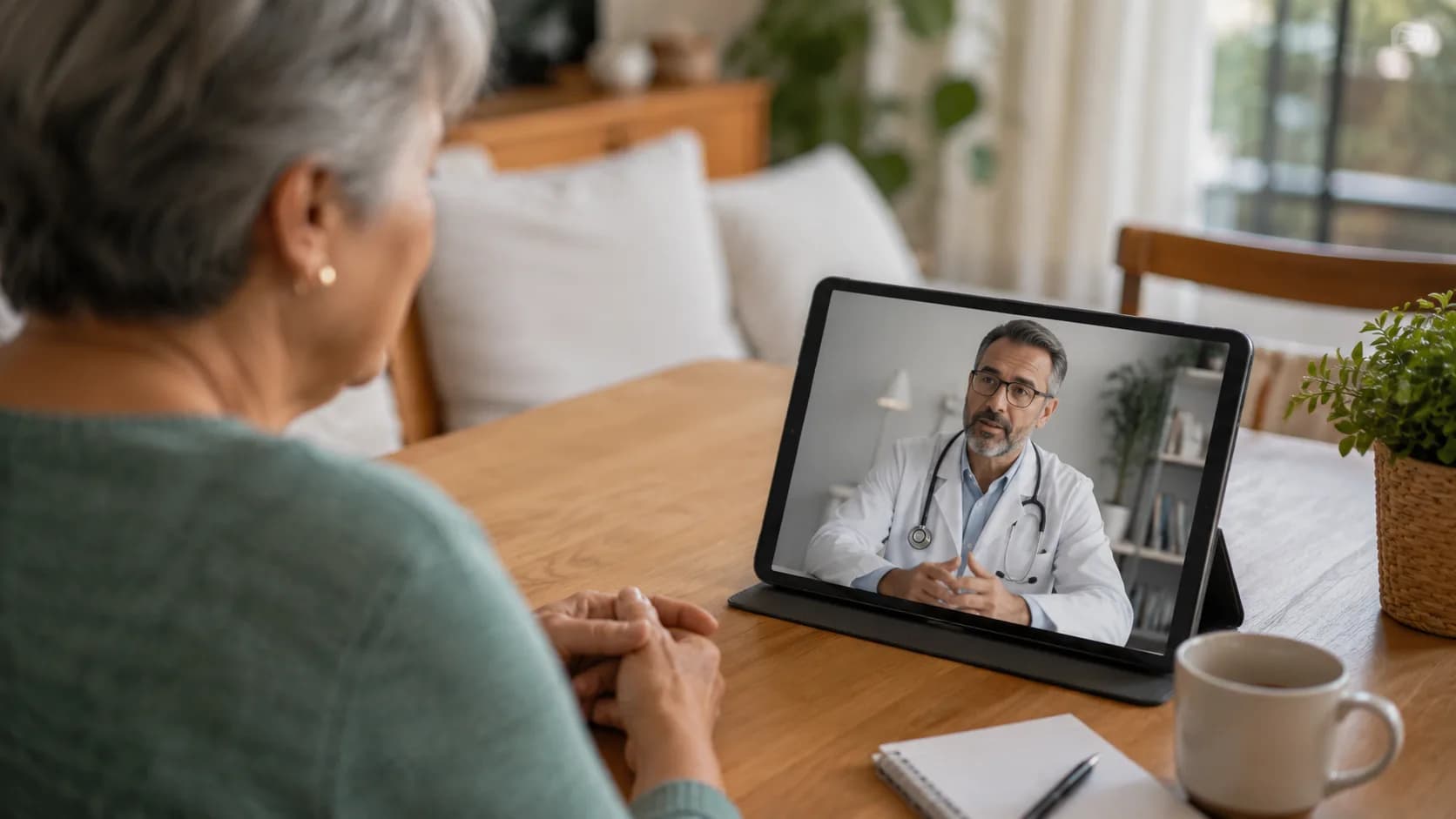
Who this service is for
This geriatric health consultation with a general practitioner is indicated for people aged 60 or older — and for their family members and caregivers — with:
- Multiple medications that need review — polypharmacy with five or more simultaneous medications
- Memory or cognition concerns — frequent forgetfulness, confusion, disorientation
- History of falls or fear of falling — assessment of risk factors and guidance on prevention
- Multiple chronic diseases — hypertension, diabetes, hypothyroidism, heart failure — that need integrated follow-up
- Symptoms of depression or social isolation — very common and often underdiagnosed in older adults
- Difficulty getting to the office — reduced mobility, dependence on others for transportation
- Questions about vaccinations for older adults — specific vaccination schedule for people over 60
- Caregivers and family members who want guidance on how to care for an older adult at home
- Foreign seniors and expats in Brazil — care in English, Portuguese, and Spanish
- Family members of older adults in Brazil who live abroad — guidance on how to monitor the family member’s health remotely
What is included in the consultation
Basic geriatric clinical assessment
The physician carries out a complete clinical assessment adapted to the older patient — including full health history, assessment of current chronic conditions, medications in use, current symptoms, and assessment of basic functional status — ability to carry out day-to-day activities independently.
Medication review — polypharmacy
Medication review is one of the interventions with the greatest impact on older adults’ health. The physician evaluates all medications in use — identifying duplications, drug interactions, medications potentially inappropriate for older adults (Beers criteria), and opportunities to simplify the therapeutic regimen. More than 40% of Brazilian older adults use five or more medications simultaneously — polypharmacy is one of the main risk factors for falls, mental confusion, and avoidable hospitalizations in older adults.
Basic cognitive screening
The physician carries out basic cognitive screening by video call — using validated instruments such as the Mini-Mental State Examination (MMSE) adapted for teleconsultation and the clock test. Where significant cognitive decline is suspected, the physician refers to neurology or geriatrics for a complete specialized assessment.
Depression screening in older adults
Depression is very common in older adults and often presents symptoms different from those of younger adults — with social isolation, loss of appetite, unexplained physical complaints, and irritability instead of expressed sadness. The physician applies the Geriatric Depression Scale (GDS) and assesses the presence of depression.
Fall risk assessment
Falls are the leading cause of trauma-related mortality in older adults in Brazil. The physician assesses the main risk factors by video call — medications that cause dizziness or postural hypotension, vision problems, muscle strength, inappropriate footwear, and environmental risks at home — and provides guidance on preventive measures.
Guidance on vaccination for older adults
The specific vaccination schedule for people over 60 in Brazil includes vaccines that are not routine in younger adults. The physician assesses the vaccination history and provides guidance on the recommended vaccines — annual influenza, pneumococcal, shingles, hepatitis B if not vaccinated, and others.
Request for tests
The physician requests laboratory and imaging tests indicated for the assessment and follow-up of the older adult — complete blood count, kidney and liver function, glucose, lipid profile, thyroid function, vitamin D, vitamin B12, and others according to the individual clinical profile.
Guidance for caregivers and family members
An important part of geriatric consultation is guiding caregivers and family members — on how to manage medications at home, how to identify warning signs that require urgent in-person care, how to adapt the home environment to reduce the risk of falls, and how to support the older adult with reduced mobility.
Referral to a specialist — when indicated
When the presentation requires specialized geriatric, neurological, cardiological, or other specialist assessment, the physician refers with complete clinical documentation.
Polypharmacy in older adults — the invisible problem
Polypharmacy — defined as the use of five or more medications simultaneously — affects more than 40% of Brazilian older adults. It is one of the most prevalent and least discussed health problems in older adult health in Brazil.
The problem is not just the number of medications — it is what happens when many medications interact with one another and with older adults’ physiology, which metabolizes medications differently from younger adults:
- Drop in blood pressure when standing up (orthostatic hypotension) — one of the main risk factors for falls, often caused by a combination of antihypertensives, diuretics, and other medications
- Mental confusion and sedation — benzodiazepines, antihistamines, and other medications with a sedative effect are particularly problematic in older adults
- Kidney failure due to medications — NSAIDs, contrast, and other nephrotoxic medications carry increased risk in older adults with reduced kidney function
- Falls — multiple medications that affect the central nervous system or blood pressure significantly increase the risk of falls
The Beers Criteria are a list of medications potentially inappropriate for older adults — developed by the American Geriatrics Society and widely used in Brazil. The physician evaluates the older adult’s current medication list based on these criteria during the review.
Memory and cognition — when to be concerned
Some forgetfulness is normal with aging. But frequent forgetfulness, confusion about dates or places, difficulty carrying out usual tasks, or changes in personality and behavior may be signs of cognitive decline that deserve medical evaluation.
The physician assesses by video call:
- Memory complaints — distinguishing between benign age-related forgetfulness and signs of pathological cognitive decline
- MMSE screening — basic assessment of orientation, memory, attention, language, and visuospatial function
- Clock test — quick assessment of executive function and visuospatial ability
- Functional impact — whether memory decline is affecting the ability to perform day-to-day activities independently
A formal diagnosis of dementia requires a complete neuropsychological assessment, neuroimaging, and a consultation with a neurologist or geriatrician. Screening by teleconsultation allows identification of when this specialized assessment is necessary — and speeds up referral.
Warning signs that require urgent referral:
- Sudden-onset mental confusion — may be delirium due to infection, medication, or another treatable cause
- Sudden change in behavior
- New-onset hallucinations or paranoia
- Sudden difficulty speaking or understanding
Fall prevention — a priority in older adult health
In Brazil, falls are the leading cause of death from external causes in older adults over 80 and the leading cause of trauma-related hospitalization in older adults. Approximately one-third of older adults fall at least once a year — and half of those who fall fall again.
The physician assesses the main modifiable risk factors by video call:
Medication factors:
- Medications that cause dizziness or postural hypotension
- Benzodiazepines and other sedatives
- Diuretics that cause urinary urgency and a risk of falling while rushing to the bathroom
- Polypharmacy in general
Clinical factors:
- Orthostatic hypotension — drop in blood pressure when standing up
- Uncorrected vision problems
- Muscle weakness — sarcopenia
- Balance problems
Environmental factors — assessable by video call:
During the consultation, the physician may ask the older adult or caregiver to show the home environment on camera — identifying loose rugs, lack of handrails in the bathroom, inadequate lighting, and other modifiable environmental risks.
Prevention guidance:
- Physical exercise — especially strength and balance training — is the most effective intervention for fall prevention
- Vitamin D supplementation when deficient — associated with muscle strength and fall risk
- Home adaptations — grab bars in the bathroom, non-slip rugs, adequate lighting
- Appropriate footwear — non-slip sole, no heel, secure fit
- Referral to geriatric physiotherapy when indicated
Vaccination for older adults in Brazil
The National Immunization Program (PNI) has a specific vaccination schedule for people over 60 — with vaccines that are not routine in younger adults and that have a significant impact on older adults’ health.
Vaccines recommended for older adults in Brazil by the PNI:
- Influenza — annually, preferably before winter. Available free of charge through the SUS
- Pneumococcal — against bacterial pneumonia. Available free of charge through the SUS for people over 60
- Herpes zoster — prevention of shingles, much more serious in older adults. Available in the private network
- Hepatitis B — for older adults who are not vaccinated or have no documented vaccination history
- dTpa — booster for diphtheria, tetanus, and pertussis, especially important for grandparents who will have contact with babies
- COVID-19 — booster doses according to the current recommendation of the Ministry of Health
Vaccination requires in-person administration at the UBS, vaccination clinic, or health post. The physician assesses the current vaccination schedule, identifies overdue or indicated vaccines, and provides guidance on where to receive them — but cannot administer vaccines remotely.
Older adult health in Brazil — the context
Brazil is aging rapidly. In 2024, the population over 60 already represents more than 15% of the population — approximately 32 million people — and this proportion is expected to reach 25% by 2040. It is the fastest-aging country in Latin America.
The Older Adults Statute (Law 10.741/2003) defines as an older adult any person aged 60 or older and guarantees a series of rights — including priority access to health services. In practice, however, access to quality geriatric health care remains a significant challenge in Brazil:
- Brazil has only about 3,000 geriatricians for a population of 32 million older adults — a ratio far below needs
- Access to geriatricians through the SUS has waiting lists of months to years in most states
- Many older adults have difficulty traveling to in-person consultations — especially those with reduced mobility, who live in rural areas, or who do not have family members available to accompany them
The geriatric health teleconsultation with a general practitioner is a practical solution for most basic geriatric health needs — without the older adult needing to leave home.
Guidance for family members and caregivers
Many geriatric health consultations are initiated not by the older adult themself, but by concerned family members — children, grandchildren, spouses — who notice changes in the behavior, memory, or functional capacity of the older family member.
This consultation is suitable for:
- Children who live far away — who want a doctor to evaluate the father or mother who lives in another state or city
- Formal caregivers — who have questions about the medication, care, or warning signs of the older adult they assist
- Family members abroad — who want to monitor the health of an older relative in Brazil remotely
During the consultation, the family member or caregiver may be present — and it is often essential that they are, especially when the older adult has difficulty communicating or cognitive impairment.