
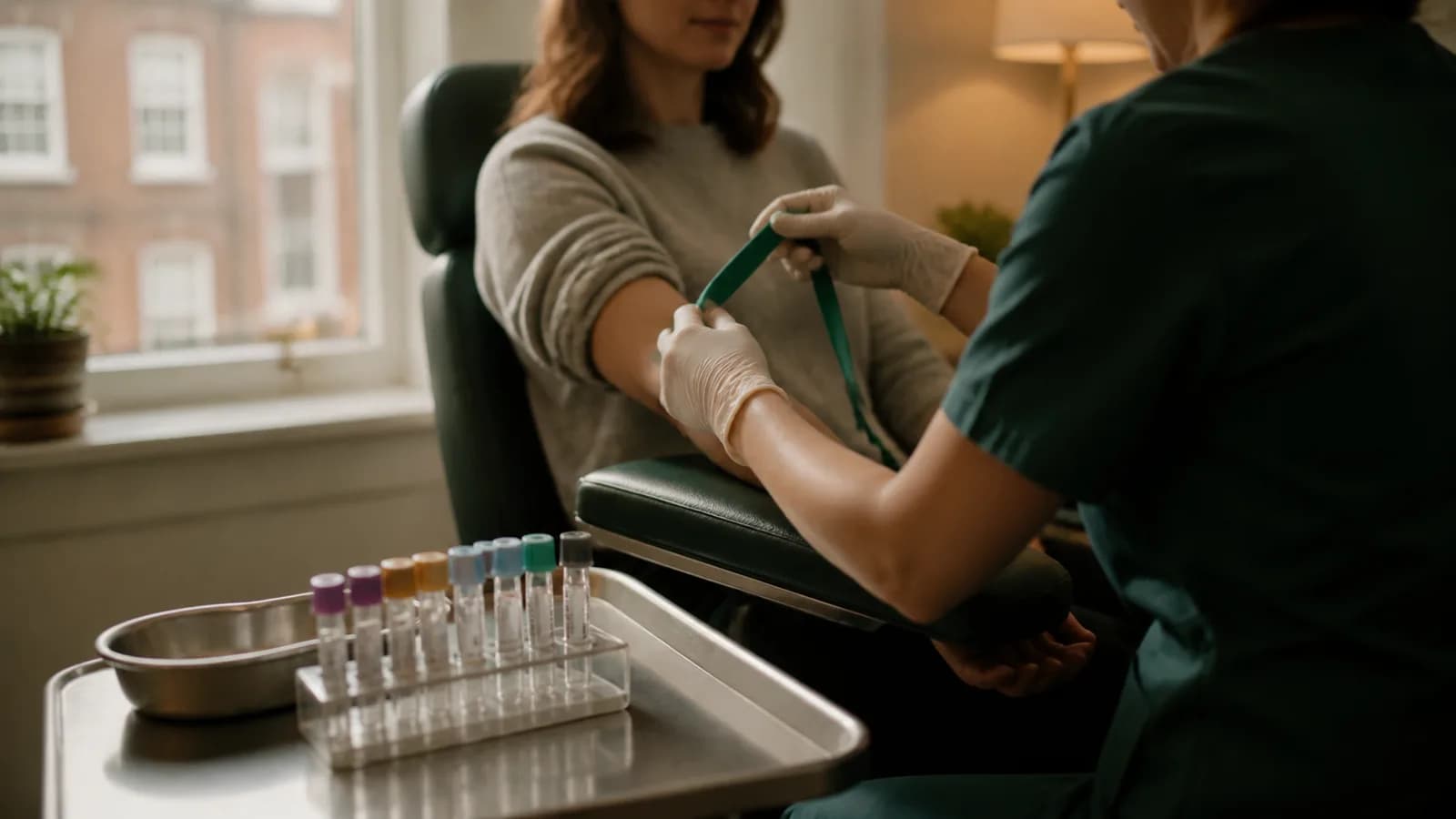
Getting blood taken is the easy part. Choosing the right test, and knowing what the number means afterwards, is the part that needs a doctor.
In Dublin you can have blood taken at your GP practice, at a hospital phlebotomy service if you have been referred, or at a private clinic or laboratory that takes direct bookings. What differs between them is not the needle — it is whether anyone decided which tests you needed, and whether anyone will interpret the result in the context of your symptoms. A panel bought off a menu can reassure you about something you were never at risk of while missing the thing that brought you in.
Access
Where you can have bloods taken in Dublin
Three routes, and they are not interchangeable — they differ in who decides what is tested and who explains the result.
- Your GP practice. The doctor who knows your history decides the tests, and the result comes back to the person who ordered it. This is the route that produces the fewest orphaned numbers.
- Hospital phlebotomy. Used when a hospital clinician has requested specific bloods, often before or after an outpatient appointment. You generally need the request to attend.
- A private clinic or laboratory. Direct booking, quick appointments, wide menus of panels. Convenient, and genuinely useful when you know what you need — but you are choosing the tests yourself unless a doctor is involved.
There is also home phlebotomy, where a nurse or phlebotomist attends you. The same principle applies: the collection is straightforward, and the clinical value comes from what was requested and who reads it.
If you want the middle ground — a doctor deciding what to test, then a lab appointment — that is what a consultation and referral is for. Ours is specialist referral and diagnostic investigations, and the panels we can arrange are listed under lab tests.
The real question
Do you need a GP referral for a private blood test?
For most direct-booking private panels, no. Whether you should have one is a different question.
Private providers in Dublin will generally take your booking without a referral. The reason to involve a doctor anyway is not gatekeeping — it is that the choice of test is the diagnosis in progress. Tiredness, for example, is not one test. Depending on your age, your history, your medication and what else you have noticed, it might point at iron studies, thyroid function, coeliac screening, glucose handling, kidney function, or none of those.
- A doctor narrows a symptom to the tests that can actually change what happens next.
- A doctor knows which of your medications distort which results, and when in the day or cycle a sample should be taken.
- A doctor is who acts on an abnormal result. A result with nobody responsible for it is the most common failure in direct-to-consumer testing.
Plain English
What the common tests actually measure
These are the panels you will see on nearly every menu in the city, and what each one is really for.
- Full blood count (FBC). The cells themselves — red cells, white cells, platelets. Used to look for anaemia, infection and clotting problems.
- Urea and electrolytes (U&E). Kidney function and the salt and water balance the kidneys control.
- Liver function tests (LFTs). A group of enzymes and proteins that shift when the liver or bile ducts are irritated, obstructed or inflamed.
- Thyroid function (TSH, and sometimes T4). Whether the thyroid is running fast, slow, or normally.
- Lipid profile. Cholesterol fractions and triglycerides, used for cardiovascular risk rather than for how you feel today.
- HbA1c. An average of your blood glucose over the preceding months — used to diagnose and monitor diabetes.
- Ferritin and iron studies. Iron stores, which explain a large share of unexplained fatigue, particularly in menstruating women.
- Vitamin D. Relevant in Ireland for straightforward geographical reasons, and worth testing when there is a reason to.
- CRP. A general marker of inflammation. It tells you something is going on; it does not tell you what.
Notice what none of these do: none of them diagnose a disease by themselves. They narrow possibilities. The narrowing only works if someone knows what you came in with.
General patient information on blood tests: HSE.
Practical
Fasting, timing and what to bring
Most bloods need no preparation at all. A few need quite specific preparation, and getting it wrong means repeating the sample.
- Fasting is required for some tests and irrelevant for others. Do not fast speculatively — ask the requesting doctor or the clinic whether your specific tests need it, and follow that.
- Drink water unless told otherwise. Well-hydrated veins make the draw faster and reduce the chance of a second attempt.
- Timing matters for some hormones. Certain results vary through the day or across the menstrual cycle, and the request should say when to attend.
- Bring your medication list, including supplements. Biotin in particular can interfere with some laboratory assays, and high-dose supplements can distort exactly the level you are trying to measure.
- Bring photo ID and your details as they appear on the request, so the sample is labelled to the right person.
If you have fainted during a blood draw before, say so before the needle rather than after. It is common, it is manageable, and being lain down beforehand is far better than being caught.
Interpretation
Why one out-of-range number rarely means what it looks like
Reference ranges are not the boundary between healthy and ill. They describe where most results in a reference population sit.
A value slightly outside the range printed on your report can be entirely normal for you. A value inside the range can still be wrong for you — a ferritin at the bottom of range in a woman with heavy periods and exhaustion is a finding, even though nothing is flagged. This is why the report and the interpretation are different things.
- Ranges are specific to the laboratory that ran the sample. Comparing your number to one you found online, or to a friend's report from another lab, is not a like-for-like comparison.
- Trend beats snapshot. Two results months apart usually say more than one result in isolation.
- Recent illness, intense exercise, alcohol, dehydration and some supplements all move results without any disease being present.
- An unexpected abnormal result is often repeated before anything is concluded from it. That is good practice, not indecision.
Safety
When a blood test is the wrong next step
Some presentations need assessment now, not a sample and a wait for results.
- Chest pain or pressure, particularly with breathlessness, sweating, or pain into the arm or jaw.
- Sudden weakness, facial droop, difficulty speaking, or a sudden severe headache.
- Difficulty breathing at rest.
- A rash that does not fade under pressure, especially with fever, neck stiffness or confusion.
- Heavy bleeding, or vomiting blood or material that looks like coffee grounds.
- Unexplained weight loss, drenching night sweats, or a lump that is growing — these need to be seen and examined, not simply screened.
For the first four, call 112 or 999, or go to your nearest Emergency Department. For the others, book an assessment rather than a panel — the examination is what directs the testing.
Global Health Ireland
Where to go from here
Our Irish GPs consult by video, decide which tests are worth doing in your case, and go through the report with you afterwards.
- Consultation, referral and diagnostic investigations
- Lab tests available through Global Health Ireland
- Meet the doctors registered with our Irish service
- Contact Global Health Ireland
Have a doctor choose the tests
A short video consultation turns a symptom into a specific request, and gives you someone responsible for the result when it comes back.
Official sources
Where to check things independently
Patient information on blood tests, and how to confirm that whoever interprets your result is registered to practise in Ireland.
Links open on the issuing body's own website. Reference ranges quoted on your own laboratory report always take precedence over any general information, including this article.
FAQ
Common questions
Where can I get a blood test in Dublin?
At your GP practice, at a hospital phlebotomy service if a hospital clinician has requested it, or at a private clinic or laboratory that takes direct bookings. Home phlebotomy is also available. The difference between them is who decides which tests are done and who interprets the result, not the draw itself.
Do I need a GP referral for a private blood test?
Usually not — most private providers accept direct bookings. Involving a doctor is still worth it, because choosing the right tests for your symptoms is part of the diagnosis, and because an abnormal result needs someone clinically responsible for acting on it.
Do I need to fast before a blood test?
It depends entirely on which tests are being done. Some require fasting, most do not. Ask the doctor who requested the tests, or the clinic taking the sample, rather than fasting speculatively. Drink water unless you have been told otherwise.
How long do blood test results take?
It varies by test and by laboratory — routine panels are typically quick, while specialised assays are sent on and take longer. The clinic taking your sample can tell you the expected turnaround for the specific tests you are having.
What does it mean if one result is outside the normal range?
Often very little on its own. Reference ranges describe where most results in a reference population fall, they are specific to the laboratory that ran your sample, and recent illness, exercise, dehydration or supplements can move values without any disease. An unexpected abnormal result is usually repeated before conclusions are drawn.
Can I get a blood test without seeing a doctor at all?
Yes, through direct-booking private providers. The trade-off is that you are selecting the panel yourself and there is nobody clinically responsible for the report. If the reason you want testing is a symptom rather than curiosity, a consultation first will usually produce a more useful set of tests.