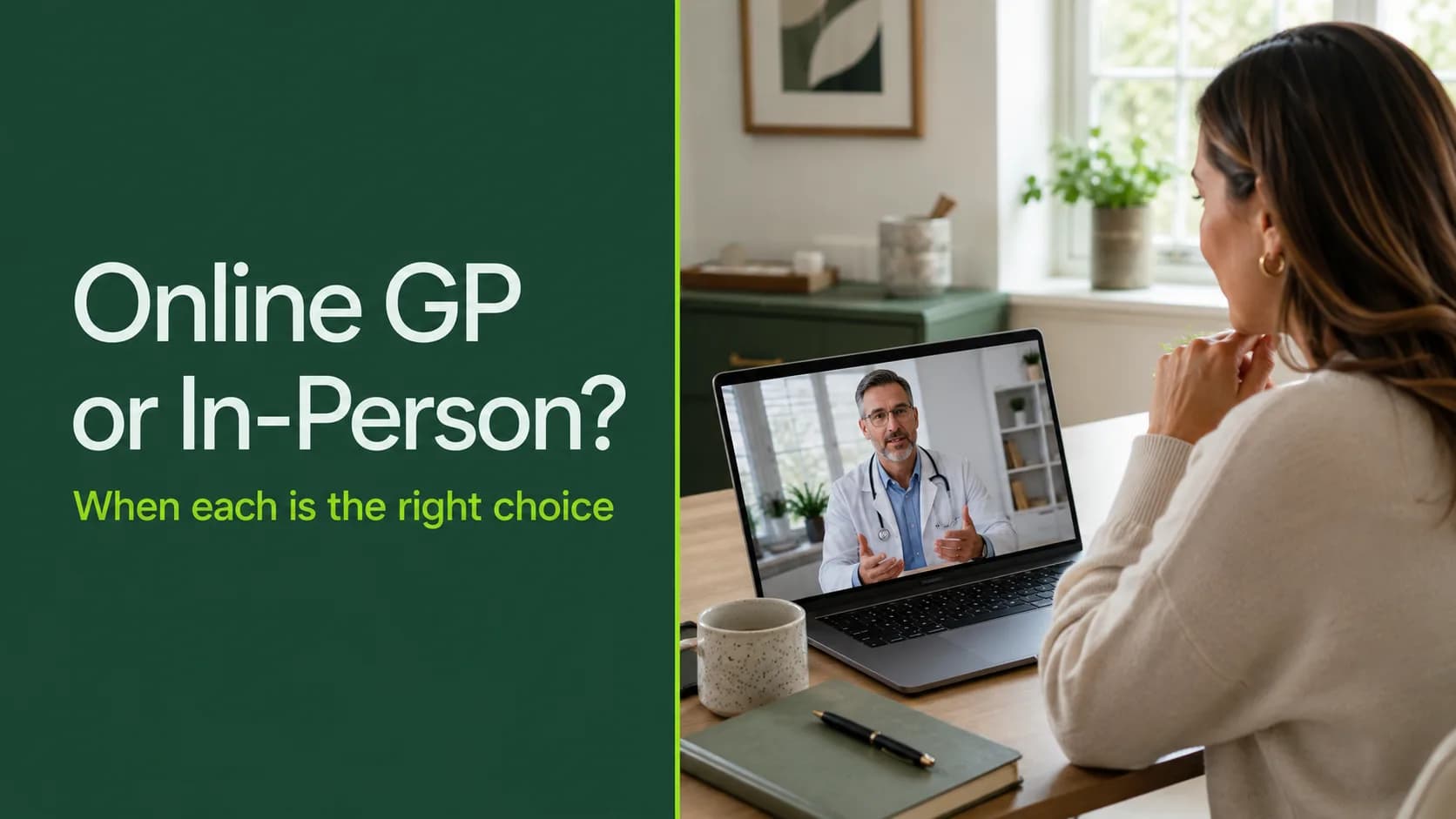
A symptom-based guide to telehealth, in-person GP care and emergency services.
Telehealth has made seeing a doctor faster and more convenient than ever — but it is not the right choice for every symptom. Choosing the wrong care pathway can delay a diagnosis that needs to be made in person, or can mean an unnecessary trip to a busy Emergency Department for something that could have been resolved from home in fifteen minutes. This guide sets out, symptom by symptom, when an online consultation is appropriate, when you need to be examined in person, and when you should call 999/112 or go straight to the Emergency Department.
Section 01
Why the Choice Matters
Telehealth removed the biggest barrier to getting medical advice — availability — but it did not remove the need for a physical examination in many conditions.
Since the COVID-19 pandemic, online GP consultations have become a mainstream part of care across Ireland, the UK and the EU. The World Health Organization and the International Telecommunication Union have jointly published implementation guidance recognising telemedicine as "an accessible, cost-effective approach" to extending care, provided it is deployed appropriately and does not replace examination-dependent care where one is needed.
The single most useful question to ask yourself before booking an online consultation is: "Does a doctor need to physically examine me, or run an immediate test, to work out what's wrong or to treat me safely?" If the answer is no — for example, a treatment review, a review of symptoms you can describe accurately, or a sick certificate for an illness you've already been diagnosed with — telehealth is usually the faster, more convenient option. If the answer is yes, or you are not sure, in-person care is the safer choice.
It's also worth understanding what telehealth cannot do, so expectations are set correctly before you book. An online doctor cannot listen to your lungs with a stethoscope, palpate your abdomen, take your blood pressure, look inside your ear canal, or run a rapid strep or urine dipstick test in the room — all things a physical examination provides instantly. For a large share of everyday GP consultations, none of this changes the outcome: a treatment review, a follow-up review, or a sick certificate for a condition you've already been diagnosed with doesn't need any of it. But for a new, undiagnosed symptom, the absence of a hands-on exam is precisely why an online GP will sometimes tell you, part-way through a video call, that you need to be seen in person instead — and that referral back to in-person care is a feature of safe telehealth, not a failure of it.
Section 02
When Online Care Is Appropriate
Telehealth suits conditions that can be assessed through a conversation, photos, and your reported symptoms and history — where no hands-on examination or urgent diagnostic is required.
- Treatment and medication reviews for a stable, previously diagnosed condition
- Sick certificates for common, self-limiting illnesses (colds, flu, gastroenteritis, migraine)
- Skin conditions that can be assessed from clear photographs (rashes, mild acne, eczema flare-ups)
- Cold and flu symptoms, sore throat, sinus congestion without difficulty breathing
- Follow-up reviews after a previous in-person diagnosis or hospital discharge
- Mild, uncomplicated urinary tract infection symptoms in adults with no fever or flank pain
- Contraception queries, contraceptive treatment reviews and general sexual health advice
- Mental health check-ins, mild-to-moderate anxiety or low mood, medication reviews
- Travel health advice and general lifestyle or preventive health questions
- Referral letters for blood tests, imaging or specialist review where a physical exam isn't needed first
The HSE's own guidance on GP out-of-hours services makes a similar distinction for phone-based care: it is intended for urgent matters that can be assessed and advised on remotely, not as a substitute for a hands-on examination when one is clinically necessary. An online GP will always tell you to seek in-person or emergency care if your symptoms fall outside what can be safely assessed remotely.
One of the most common reasons people delay seeking any care at all — online or in-person — is simply not being able to get an appointment quickly enough during a working day. Telehealth removes that barrier for the conditions listed above: a video consultation can typically be booked and completed within the hour, rather than waiting days for the next in-person GP slot, which matters most for time-sensitive but low-risk situations such as a sick certificate needed before a shift, or a regular medicine running low over a bank holiday weekend. The convenience gain is real, but it should never be the reason a genuinely examination-dependent symptom gets treated online instead of in person — convenience is a tie-breaker between two safe options, not a reason to choose an unsafe one.
Section 03
When You Need to Be Seen in Person
Some conditions genuinely require hands-on examination, in-clinic diagnostics, or same-day physical assessment — no amount of description or photographs can safely replace this.
- Abdominal pain that is severe, localised, or accompanied by fever or vomiting
- Chest pain, palpitations, or any new cardiac symptom
- A suspected fracture, dislocation, or deep wound needing sutures
- Symptoms needing a physical exam to rule out something serious (e.g. testicular pain, unexplained lumps)
- Ear pain in young children where the eardrum needs to be examined
- Persistent high fever, especially in infants, older adults, or the immunocompromised
- Any symptom that requires blood pressure, oxygen saturation, or auscultation to assess safely
- Pregnancy-related bleeding, pain, or reduced fetal movement
- Eye injuries, sudden vision changes, or a red, painful eye
- Symptoms that have already been assessed online and the doctor has advised an in-person review
Your GP surgery, or the HSE's urgent and emergency care service finder, can help you locate the right in-person option — GP surgery, GP out-of-hours service, injury unit, or Emergency Department — based on how urgent your symptoms are.
Section 04
Emergency Warning Signs — Call 999/112
Some symptoms are never appropriate for an online consultation, and should never wait for any appointment at all.
In the UK, the equivalent guidance from the NHS on when to use 111 versus 999 draws the same line: 999 is reserved for life-threatening emergencies, while non-urgent-but-can't-wait symptoms are triaged through 111 or an equivalent out-of-hours service, and routine care goes through your usual GP.
Section 05
Special Considerations for Children
Children can deteriorate quickly, and their symptoms are harder to self-report accurately — err on the side of a lower threshold for in-person review.
An online consultation can be appropriate for a child with a mild cold, a stable skin rash, or a straightforward medication query. However, parents and carers should seek in-person or emergency care without delay for a baby or young child who has: a high fever that doesn't settle with paracetamol or ibuprofen, especially under 3 months old; reduced feeding, persistent vomiting, or signs of dehydration (fewer wet nappies, sunken eyes); unusual drowsiness, floppiness, or difficulty waking; a rash that doesn't fade under pressure (the "glass test"); difficulty breathing, grunting, or blue lips; or a seizure. If you are ever unsure with a child, the safer choice is always an in-person assessment or a call to 999/112.
Section 06
How an Online GP Consultation Works
A good telehealth service triages you first, so you're only offered an online appointment when it's genuinely appropriate.
At Global Health, every booking begins with a short symptom questionnaire. If your symptoms suggest you need to be seen in person or require emergency care, you're told this immediately, before any appointment is booked — an online consultation should never be a barrier that delays appropriate escalation. Where an online consultation is appropriate, an Irish Medical Council-registered GP reviews your history over video or phone, can issue treatment plans electronically to your local pharmacy, issue sick certificates where clinically appropriate, and refer you for blood tests, imaging or specialist review when needed.
Not sure which type of care you need?
Global Health's online GP service triages every booking by symptom first, so you're only offered a video consultation when it's clinically appropriate — and directed to in-person or emergency care immediately when it isn't.
Section 07
Key Resources
These official sources set the guidance this article is based on.
Source: HSE urgent and emergency care guidance; NHS 111 service guidance; WHO/ITU joint telehealth accessibility guidance (2024).
Section 08
Frequently Asked Questions
Can an online GP diagnose me as accurately as an in-person visit?
For many conditions — medication reviews, follow-ups, skin conditions visible on camera, and symptom-based illnesses like colds or migraines — yes. But some diagnoses depend on physical findings (listening to your chest, feeling your abdomen, checking your ears) that simply cannot be replicated remotely. A responsible online GP will always tell you when an in-person examination is needed rather than guessing.
Can an online doctor issue a sick certificate?
Yes, where clinically appropriate for the condition described. Sick certificates for online consultations are treated the same as those from an in-person GP visit for employment purposes in Ireland.
What should I do if I'm not sure whether my symptoms are an emergency?
If you're unsure, treat it as urgent: call 999/112 or attend your nearest Emergency Department. It is always safer to be assessed and told you didn't need to come in than to wait at home with something serious.
Will an online GP refer me for blood tests or imaging?
Yes. Online GPs can issue referrals for blood tests, imaging and specialist review in the same way an in-person GP can, without requiring you to first be examined in person, unless your specific symptoms require it.
Is online GP care suitable for children?
It can be, for mild, stable conditions. However, because children can deteriorate quickly and are harder to assess remotely, parents should have a lower threshold for seeking in-person or emergency care — particularly for infants under 3 months, high fevers, breathing difficulty, or reduced responsiveness.
How quickly can I get an online GP appointment with Global Health?
Global Health offers online GP consultations with Irish Medical Council-registered doctors, often on the same day, from €39. Every booking starts with a short symptom triage so you're only offered a video consultation when it's the right choice — and pointed to in-person or emergency care immediately if it isn't. Book at myglobalhealth.online or email globalhealth@myglobalhealth.online.