
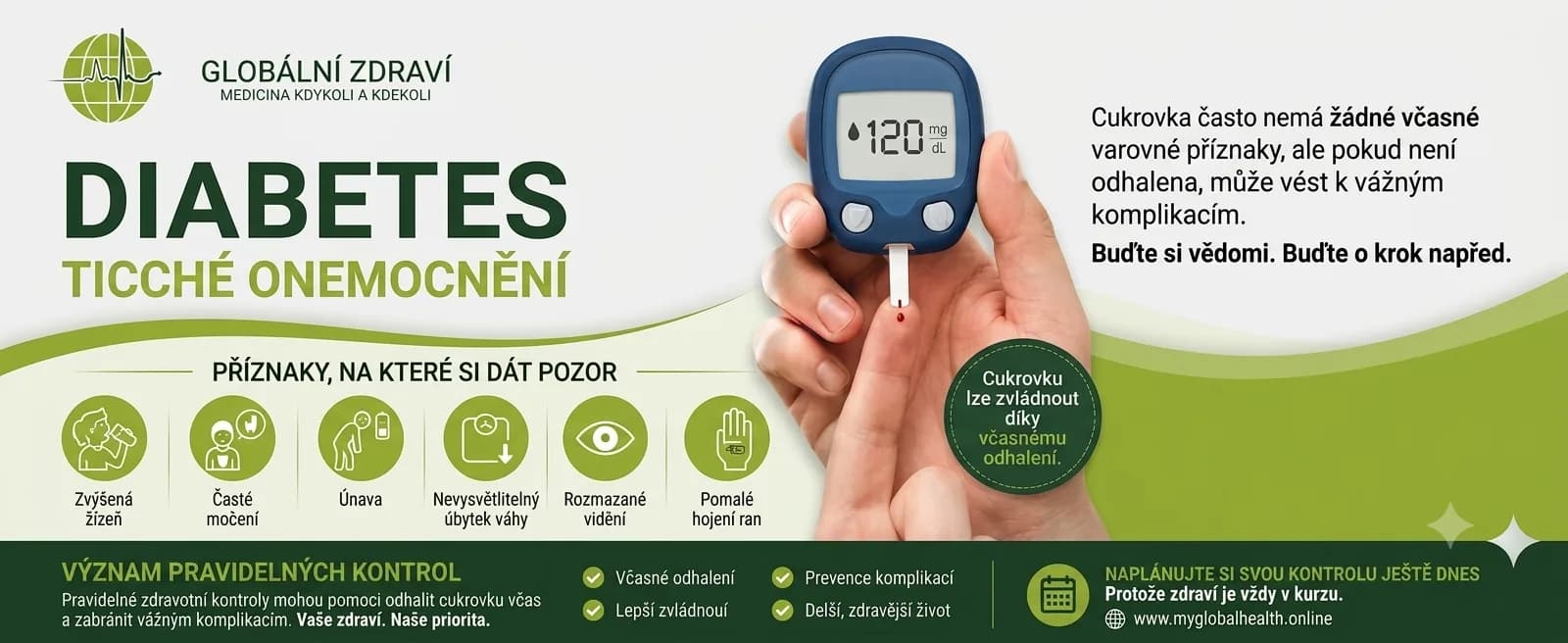
An estimated 10% of people in the Czech Republic live with diabetes, and thousands more don't yet know they have it. This guide covers everything you need to know: causes, warning signs, treatment approaches that follow current diabetes management guidelines, why regular checkups matter, and the emerging therapies that could transform diabetes care in the years ahead.
Diabetes mellitus — commonly known as diabetes — is one of the most widespread chronic conditions in the Czech Republic, and one of the most underestimated. Type 2 diabetes, which accounts for around 92% of all cases, can develop quietly over many years without causing obvious symptoms. By the time many patients are diagnosed, the disease has already been present for some time.
The good news is that diabetes is highly manageable with the right treatment and regular monitoring. People with diabetes can lead full, healthy lives. The last decade in particular has brought breakthrough advances in treatment, most notably the arrival of GLP-1 receptor agonists and SGLT2 inhibitors, and treatment options today are stronger than ever.
Section 01
Diabetes in the Czech Republic: the scale of the problem
According to data from the Czech Statistical Office (ČSÚ), approximately 884,500 people were being treated for diabetes with medication in 2024. The Institute of Health Information and Statistics of the Czech Republic (ÚZIS ČR), which maintains the National Diabetes Registry (NDR), estimates that diabetes mellitus affects approximately 10% of the Czech population. The Czech Republic consistently ranks among the countries with the highest diabetes prevalence in the European Union, a trend also documented by the Czech Diabetes Association.
EU
Source: Czech Statistical Office (ČSÚ) 2024; ÚZIS ČR — National Diabetes Registry; Czech Diabetes Association; NZIP.
Projections from ÚZIS ČR, based on data from the National Registry of Reimbursed Health Services (NRHZS), show that the number of people with diabetes in the Czech Republic is on an upward trend and, without significant lifestyle changes across the population, will continue to rise in the coming years. A research article from FN Motol (Vnitřní lékařství 2025;71(3):144–151) highlights the need for an individualized approach to treatment, with an emphasis on cardiovascular and renal protection.
Section 02
Types of diabetes
Diabetes isn't a single disease. Understanding which type you have — or which type you're at risk for — is the first step toward effective treatment.
Section 03
Causes and risk factors
Type 1 diabetes
The exact cause of T1D isn't fully understood. It's an autoimmune condition in which the immune system mistakenly attacks and destroys the insulin-producing beta cells of the pancreas. Genetic factors play a role, and exposure to certain viral infections is also thought to contribute. Research in this area in the Czech Republic is coordinated through the Czech Diabetes Society ČLS JEP (ČDS) and institutions such as Motol University Hospital and Brno University Hospital.
Type 2 diabetes
T2D has more complex, and largely modifiable, causes: a combination of genetic predisposition with lifestyle and environmental factors. The key mechanism is insulin resistance (the body's cells stop responding effectively to insulin), paired with a gradual decline in the pancreas's ability to compensate with higher output.
Section 04
Signs and symptoms of diabetes
Symptoms differ significantly between T1D and T2D. T1D often presents acutely, with a rapid onset of symptoms that can signal diabetic ketoacidosis (DKA), a life-threatening condition. T2D, by contrast, typically develops slowly and quietly over years, with symptoms mild or gradual enough that many people attribute them to aging, stress, or fatigue.
Section 05
Current treatment options for diabetes in the Czech Republic
Diabetes treatment has undergone a genuine revolution over the past decade. In the Czech Republic, clinical guidelines are issued by the Czech Diabetes Society ČLS JEP (ČDS), whose Recommended Standard of Care for Type 2 Diabetes Mellitus (updated 2020, with subsequent standards from 2021–2025) is the binding standard for diabetes clinics and GPs across the country. Drug availability is governed by the reimbursement conditions set by the State Institute for Drug Control (SÚKL).
Lifestyle changes — the foundation of all treatment
For both T1D and T2D, lifestyle is the cornerstone of treatment. In T2D, changes to diet and increased physical activity can significantly lower HbA1c, improve insulin sensitivity, and in some cases — particularly after bariatric surgery or on a very low-calorie diet — lead to lasting remission. Structured patient education is part of standard care at diabetes clinics and is also recommended in ČDS guidelines.
Pharmacological treatment
Below are the main drug classes available in the Czech Republic. Treatment decisions are individualized — both ČDS and ADA 2025 guidelines emphasize a patient-centered approach that takes into account cardiovascular risk, kidney function, body weight, and patient preference. A research article published in Vnitřní lékařství (2025;71(3):144–151), from the 2nd Faculty of Medicine, Charles University, and Motol University Hospital's Department of Internal Medicine, notes that in patients with cardiovascular disease, heart failure, or diabetic kidney disease, starting GLP-1 agonist or SGLT2 inhibitor therapy should not depend on HbA1c levels.
Section 06
Why regular medical checkups matter
Diabetes is a progressive chronic condition, and if poorly controlled, its complications can be serious and irreversible. Diabetic retinopathy is a leading cause of blindness among working-age adults in the Czech Republic. Diabetic nephropathy is a major cause of kidney failure requiring dialysis. Peripheral neuropathy contributes to diabetic foot complications, which in severe cases can lead to amputation. Cardiovascular risk is significantly elevated in people with diabetes, as noted in ČDS's 2025 Recommended Standard of Care for Diabetic Foot Syndrome.
A key finding from a decade of clinical research is that most of these complications can be largely prevented, or substantially delayed, through good blood sugar control, blood pressure management, and regular checkups. An annual, structured diabetes checkup is one of the best-evidenced and most cost-effective interventions in all of medicine.
What your annual diabetes checkup should include
- HbA1c test (average blood sugar over the past 3 months)
- Blood pressure measurement and review of antihypertensive therapy
- Kidney function — eGFR and urine albumin-to-creatinine ratio (ACR)
- Cholesterol and a full lipid profile
- Body weight and BMI assessment
- Foot exam — pulses, sensation, skin condition
- Diabetic retinopathy screening — eye exam or retinal photography
- Medication review and adjustment as needed
- Assessment of self-monitoring education
- Smoking status review and cessation support, if relevant
- Flu vaccination (strongly recommended for people with diabetes)
Screening for people not yet diagnosed
If you have risk factors for T2D and have never been tested, your GP can arrange a simple fasting glucose or HbA1c test. This is especially important if you're over 45, have a family history of diabetes, have high blood pressure, or were overweight during pregnancy. Early detection of prediabetes is a genuine opportunity to prevent or delay the onset of T2D through lifestyle changes.
Section 07
The future of diabetes treatment
The pace of innovation in diabetes care is unprecedented. Several areas of research, some already in advanced clinical trials, have the potential to fundamentally transform life with diabetes over the next decade.
Stem cell research for T1D is explored in detail in a 2025 publication in PMC (PMID: PMC12689004), which states that "stem cell therapy offers a dual strategy: regenerating insulin-producing beta cells and regulating the immune response." While a definitive cure remains a goal for the future, the direction of research has never been clearer.
Section 08
Key institutions and resources in the Czech Republic
If you're living with diabetes in the Czech Republic, or you're concerned you may be at risk, the following organizations and services are your main reference points for clinical care, education, and support.
Czech Diabetes Society ČLS JEP (ČDS)
The Czech Diabetes Society ČLS JEP is the leading professional authority on all aspects of diabetes care in the Czech Republic. It issues recommended clinical guidelines, including standards for T1D (2022), T2D (2020, with updates), diabetic kidney disease (2021), diabetic foot syndrome (2025), and preventing the progression of diabetic retinopathy with fenofibrate (2025). All documents are freely available on the ČDS website.
ÚZIS ČR and the National Diabetes Registry (NDR)
The Institute of Health Information and Statistics of the Czech Republic maintains the National Diabetes Registry and publishes open epidemiological data on diabetes through the National Health Information Portal (NZIP). This data, covering incidence, prevalence, mortality and treatment patterns since 2010, underpins diabetes health policy planning in the Czech Republic.
Czech Diabetes Association
The Czech Diabetes Association is a patient organization representing people with diabetes and their families. It provides education, advocacy, counseling, and up-to-date statistical data on diabetes in the Czech Republic, and serves as the patient voice in discussions over drug and device reimbursement.
SÚKL — State Institute for Drug Control
The State Institute for Drug Control decides on drug registration and health insurance reimbursement conditions in the Czech Republic. Its website lets you check current reimbursement conditions for specific diabetes medications, including gliflozins and GLP-1 agonists, and access summaries of product characteristics (SPCs).
Section 09
Frequently asked questions
How many people have diabetes in the Czech Republic?
According to data from the Czech Statistical Office (ČSÚ), approximately 884,500 people were being treated for diabetes with medication in 2024. ÚZIS ČR estimates that diabetes mellitus affects approximately 10% of the entire Czech population. The Czech Republic ranks among the countries with the highest diabetes prevalence in the EU. The number of people with diabetes is on an upward trend, driven by an aging population, rising obesity, and sedentary lifestyles.
What are the first signs of diabetes?
The most common symptoms include excessive thirst, frequent urination (especially at night), persistent fatigue, blurred vision, slow-healing wounds, increased appetite even after eating, and tingling or numbness in the hands and feet. Importantly, type 2 diabetes can develop slowly and without symptoms — many people have no complaints for years before diagnosis. If you have risk factors, talk to your GP about a blood test (fasting glucose or HbA1c) even in the absence of symptoms.
What's the difference between type 1 and type 2 diabetes?
Type 1 diabetes is an autoimmune condition in which the immune system destroys the insulin-producing beta cells of the pancreas. It requires lifelong insulin therapy and most often develops in childhood or early adulthood. Type 2 diabetes occurs when the body stops responding effectively to insulin or doesn't produce enough of it — it's strongly linked to lifestyle (diet, activity, weight) and genetic factors, and accounts for roughly 92% of all cases in the Czech Republic. The two forms have different causes, treatments and courses, and both require careful monitoring to prevent complications.
What treatments for type 2 diabetes follow current guidelines in the Czech Republic?
First-line treatment for T2D in the Czech Republic typically starts with metformin combined with lifestyle changes (diet and exercise). Newer drug classes — GLP-1 receptor agonists (semaglutide/Ozempic, liraglutide) and SGLT2 inhibitors/gliflozins (empagliflozin/Jardiance, dapagliflozin/Forxiga) — have revolutionized treatment. They not only lower blood sugar but also protect the heart and kidneys and help with weight loss. Both ČDS and ADA 2025 guidelines recommend prioritizing these medications for patients with cardiovascular disease, heart failure, or chronic kidney disease, regardless of HbA1c level. Treatment is always individualized to the patient's profile.
How often should I get checked for diabetes in the Czech Republic?
People with diabetes should have at least one structured annual checkup with a GP or diabetes specialist, covering HbA1c, blood pressure, kidney function, cholesterol, weight, a foot exam, and retinopathy screening. If control is inadequate, HbA1c is checked every 3 months. Patients with T1D and select groups with T2D are entitled to a reimbursed CGM system in the Czech Republic. Retinopathy screening is covered by health insurers.
Can diabetes go into remission?
Type 2 diabetes can, in some cases, go into remission — defined as achieving near-normal blood sugar levels without medication — through significant weight loss, most often following bariatric surgery or a very low-calorie diet. The landmark DiRECT trial showed remission in around 50% of participants after one year of a structured dietary program. This doesn't mean the underlying predisposition disappears — maintaining remission requires lasting lifestyle change. Type 1 diabetes currently cannot be cured, though promising stem cell therapies in clinical trials aim to restore insulin production in the years ahead.
Can I consult a doctor about diabetes online in the Czech Republic?
Yes. Global Health offers online diabetes consultations with a doctor registered with the Czech Medical Chamber, including treatment review, assessment of symptoms consistent with diabetes, medication review, and lab test referrals (HbA1c, fasting glucose, metabolic panel). Consultations take place via secure video call in Czech. Book a consultation at myglobalhealth.online or email globalhealth@myglobalhealth.online.
Have questions about diabetes? Talk to a doctor today.
Online diabetes consultations with a doctor registered with the Czech Medical Chamber. Video call in Czech. Fast appointment availability.