Causes, warning signs, current treatments, prevention, and screening for high cholesterol.
Cardiovascular disease is the leading cause of death in Portugal. And one of its main drivers, elevated blood cholesterol, affects roughly half of Portuguese adults, most of whom have no idea they have it. By its very nature, hypercholesterolemia is a condition that doesn't announce itself with symptoms, it announces itself with events: a heart attack, a stroke, sudden cardiac death.
Section 01
High Cholesterol in Portugal: The Scale of the Problem
Cholesterol is a waxy, fat-like substance made naturally by the liver and also obtained through diet. It is essential for building cell membranes, producing hormones, and synthesizing vitamin D. The problem starts when levels, particularly of low-density lipoprotein (LDL) cholesterol, cross the threshold at which arterial damage begins. That process, atherosclerosis, underlies most heart attacks and strokes.
Data from the National Institute of Health Doutor Ricardo Jorge (INSA) and the National Health Survey (INS), published by the Directorate-General of Health, show that high cholesterol is one of the most common uncontrolled cardiovascular risk factors in the Portuguese adult population. According to the DGS National Programme for Cerebro-Cardiovascular Disease, cardiovascular disease is the leading cause of death in Portugal, with high cholesterol playing a decisive role in that reality.
Source: INSA, National Health Survey; DGS, National Programme for Cerebro-Cardiovascular Disease; Portuguese Cardiology Foundation; Portuguese Association of Familial Hypercholesterolemia.
Familial hypercholesterolemia (FH) deserves particular attention. This inherited genetic condition, affecting roughly 1 in 250 people, or about 40,000 individuals in Portugal, drives dramatically elevated LDL from birth, putting those affected at risk of a heart attack often decades earlier than would otherwise be expected. The Portuguese Association of Familial Hypercholesterolemia (APHF) estimates that more than 90% of FH cases in Portugal remain undiagnosed. Without treatment, men with FH face a 50% risk of a coronary event before age 50; women before age 60.
Section 02
Types of High Cholesterol
Not all high cholesterol has the same cause or the same clinical significance. Understanding the type and pattern of your lipid abnormality guides treatment decisions.
Section 03
Causes and Risk Factors
Genetic Causes
Familial hypercholesterolemia is the most important genetic cause of premature cardiovascular disease. It results mainly from mutations in the gene that codes for the LDL receptor, the cellular mechanism through which LDL cholesterol is cleared from the bloodstream. When LDL receptors are missing or too few, LDL builds up in the blood and progressively deposits in the artery walls. The condition is autosomal dominant, meaning a single copy of the affected gene is enough to cause it. Children of an affected parent have a 50% chance of inheriting it.
Lifestyle and Environmental Causes
For most people, high cholesterol results from the intersection of genetic predisposition and lifestyle. Each of the following risk factors is independently associated with elevated LDL or total cholesterol, and combining them substantially amplifies the risk.
Section 04
Signs and Symptoms
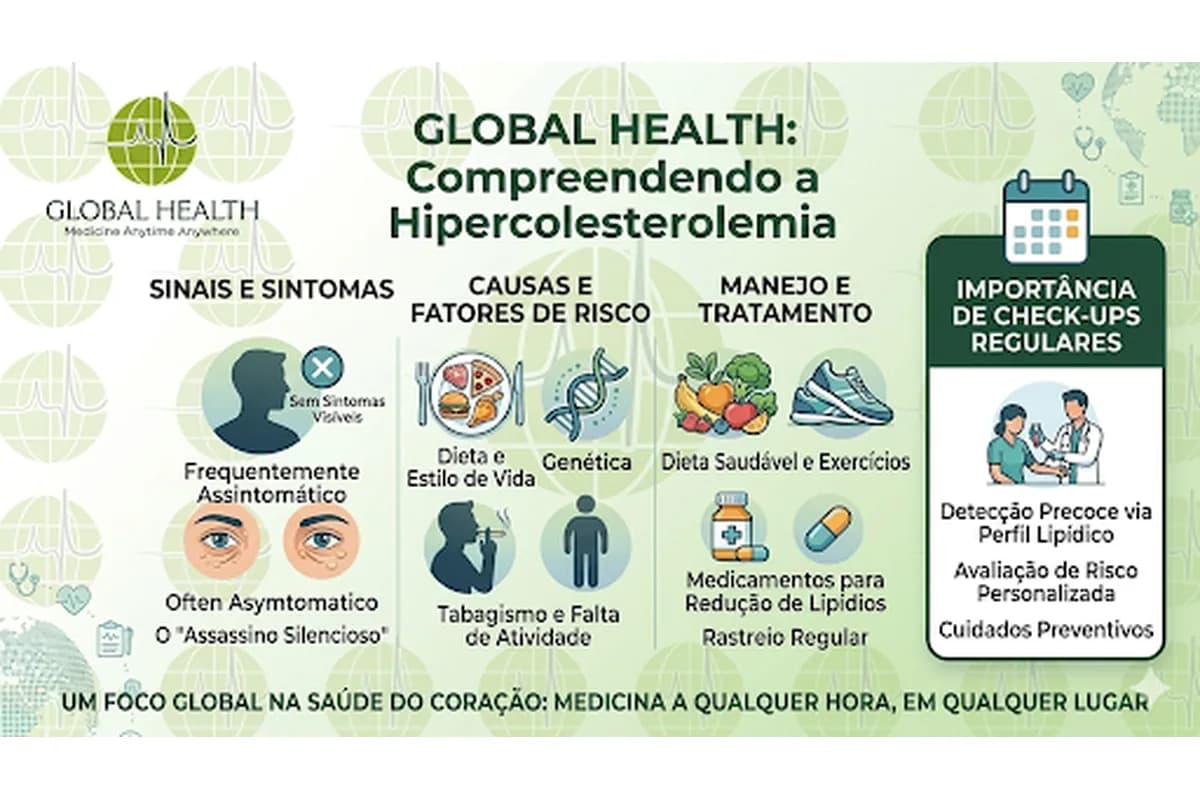
This is the central clinical challenge of high cholesterol: it is almost entirely symptom-free until significant arterial damage has occurred. There's no pain, fever, or shortness of breath caused directly by cholesterol. For many patients, the first "symptom" is a heart attack or stroke, often in someone who felt completely fine the day before.
In cases of severe or long-standing elevation, particularly in familial hypercholesterolemia, certain physical signs can appear. It's worth recognizing them, since they're often the only visible clue that a significant lipid abnormality is present:
The core clinical message is unambiguous: don't wait for symptoms. A fasting lipid profile is the only reliable way to detect high cholesterol. It's simple, affordable, and widely available through your family doctor. Having no symptoms is not proof of good health, it's precisely when acting matters most.
Section 05
Current Treatments for High Cholesterol in Portugal
Treatment of high cholesterol in Portugal follows the guidance of the Directorate-General of Health (DGS), the European Society of Cardiology (ESC) / European Atherosclerosis Society (EAS) Guidelines for the Management of Dyslipidaemias (updated in 2024), and the recommendations of the Portuguese Society of Cardiology (SPC). The treatment goal isn't defined by a single cholesterol number, but by an LDL target set according to individual cardiovascular risk, with higher-risk patients needing a more aggressive LDL reduction.
LDL Targets by Risk Category
The 2024 ESC/EAS guidelines set the following LDL goals: very high risk (established cardiovascular disease, severe kidney disease, diabetes with organ damage), LDL below 1.4 mmol/L; high risk, below 1.8 mmol/L; moderate risk, below 2.6 mmol/L; low risk, below 3.0 mmol/L. Your doctor will calculate your cardiovascular risk using validated tools (SCORE2, QRISK3) to determine which target applies to you.
Section 06
Prevention and Lifestyle: What You Can Do
Lifestyle change is the first and most sustainable intervention for managing cholesterol and lowering cardiovascular risk. For patients with low-to-moderate cardiovascular risk, dietary and lifestyle changes, kept up consistently, can achieve clinically meaningful LDL reductions and, for many, avoid the need for medication altogether. Even for those on drug therapy, lifestyle changes amplify the effectiveness of treatment and independently lower cardiovascular risk through mechanisms that go beyond cholesterol.
The Portuguese Cardiology Foundation offers free, comprehensive resources on heart-healthy habits, including dietary guides and smoking-cessation programmes tailored for Portuguese patients. The National Health Service (SNS) also offers community support for lifestyle change across the country.
Section 07
Why Regular Screening Matters
Because high cholesterol causes no symptoms, detection depends entirely on proactive blood testing. And because cardiovascular risk isn't set by cholesterol alone but by the combined effect of every risk factor over time, your full cardiovascular risk profile, not just your cholesterol number, needs regular evaluation and monitoring.
In Portugal, cholesterol screening is built into adult check-ups within SNS primary care. The DGS recommends that all adults over 40 have their cholesterol tested at least every 5 years, and more often if risk factors are present or treatment has already started.
What Your Cardiovascular Risk Assessment Should Include
- Fasting lipid profile: total cholesterol, LDL, HDL, and triglycerides
- Non-HDL cholesterol and LDL/HDL ratio calculation
- Blood pressure measurement
- Fasting glucose and HbA1c (diabetes screening)
- Thyroid function (TSH), to rule out hypothyroidism as a secondary cause
- Kidney function — eGFR and urine albumin (CKD raises cardiovascular risk)
- Weight and BMI
- Cardiovascular risk score calculation (SCORE2 or QRISK3)
- Review of family history, particularly early cardiovascular disease
- Physical exam for xanthomas, xanthelasma, and corneal arcus
- Assessment of smoking status and cessation support if applicable
- Medication review and adjustment if already on lipid-lowering therapy
Monitoring During Lipid-Lowering Therapy
After starting a statin or another lipid-lowering agent, a fasting lipid profile should be repeated 8 to 12 weeks after starting or changing dose, both to assess response and to check for adverse effects (liver enzymes, CK if muscle symptoms appear). Once a stable LDL target is reached, annual monitoring is standard. For patients on PCSK9 inhibitors or inclisiran, monitoring intervals are set by the prescribing specialist.
Cascade Screening for Familial Hypercholesterolemia
If FH is suspected, based on very high LDL, physical signs (tendon xanthomas), or a strong family history of early cardiovascular disease, cascade screening of first-degree relatives is recommended. The Portuguese Association of Familial Hypercholesterolemia (APHF) supports families affected by FH and advocates for a national cascade screening programme. Genetic testing for known FH mutations is available through specialist lipid services in Portugal, including at the São João University Hospital Centre and the Lisbon North University Hospital Centre (Santa Maria Hospital).
Section 08
Research and Future Treatments
The pace of innovation in lipid medicine is remarkable. The last decade brought PCSK9 inhibitors; this decade has already delivered inclisiran. What follows represents the research frontier that could reshape cholesterol management even further in the years ahead.
The broader scientific story of cardiovascular risk reduction is one of hard-won progress. The Cholesterol Treatment Trialists' Collaboration (CTT), the definitive meta-analysis of statin trials spanning more than 170,000 patients, published in The Lancet, established that every 1.0 mmol/L reduction in LDL produces roughly a 22% reduction in major cardiovascular events, a finding that holds across every risk group and cholesterol level. Lowering LDL more, for longer, and earlier produces greater absolute benefit. This principle now guides every modern treatment target.
Section 09
Key Portuguese Institutions
If you're living with high cholesterol or elevated cardiovascular risk in Portugal, or have concerns tied to your family history, the following organizations are your main points of reference.
Portuguese Cardiology Foundation
The Portuguese Cardiology Foundation is Portugal's leading cardiovascular health organization dedicated to public information and prevention. It offers resources on cholesterol, blood pressure, and cardiovascular risk; advocates for better access to preventive care; and promotes cardiovascular health literacy across the country. Its heart-health resources, including dietary guides and risk calculators, are freely available online.
Portuguese Association of Familial Hypercholesterolemia (APHF)
The APHF is the national organization for patients with familial hypercholesterolemia. It has consistently advocated for a national FH cascade-screening programme, better SNS access to PCSK9 inhibitors, and greater awareness of FH among both the public and primary care clinicians. If you suspect you or a family member may have FH, the APHF is an invaluable first point of contact.
DGS — National Programme for Cerebro-Cardiovascular Disease
The DGS National Programme for Cerebro-Cardiovascular Disease oversees clinical governance and care-pathway development for heart and vascular conditions in Portugal. It publishes clinical guidelines and integrated care models that shape how family doctors and specialists manage lipid disorders nationwide.
Section 10
Frequently Asked Questions
Is high cholesterol common in Portugal?
Yes. High cholesterol is one of the most prevalent modifiable cardiovascular risk factors in Portugal. Data from INSA and the National Health Survey show that roughly half of Portuguese adults have elevated total cholesterol. Most go undiagnosed, because high cholesterol causes no symptoms. Familial hypercholesterolemia, an inherited form that causes very high LDL from birth, affects about 1 in 250 people in Portugal, with more than 90% estimated to be undiagnosed.
What are the signs and symptoms of high cholesterol?
High cholesterol is essentially a silent disease, most people have no symptoms until a serious cardiovascular event occurs. In cases of severe or familial high cholesterol, physical signs can appear, such as xanthomas (fat deposits under the skin, especially on the Achilles tendon or knuckles), xanthelasma (yellowish plaques near the eyelids), and corneal arcus (a grey ring around the iris, significant in people under 45). The only reliable way to detect high cholesterol is a blood test: a fasting lipid profile.
What causes high cholesterol?
High cholesterol has both genetic and lifestyle-related causes. The most important genetic cause is familial hypercholesterolemia (FH), caused by mutations in the LDL receptor gene. Lifestyle-related causes include a diet high in saturated and trans fats, physical inactivity, obesity, smoking, and excess alcohol intake. Secondary causes include hypothyroidism, type 2 diabetes, chronic kidney disease, and certain medications. For most people, cholesterol levels are shaped by a combination of genetic predisposition and lifestyle factors.
What are the best treatments for high cholesterol in Portugal?
Treatment depends on overall cardiovascular risk and LDL target, not on the cholesterol number alone. Lifestyle change, diet, exercise, smoking cessation, weight control, is the foundation for every patient. Statins (particularly high-intensity atorvastatin and rosuvastatin) are the first-line drug treatment, widely available through the SNS in Portugal. For patients who don't reach their LDL targets, ezetimibe is added. For high-risk patients or those with familial hypercholesterolemia, PCSK9 inhibitors (evolocumab, alirocumab) and inclisiran, a twice-yearly RNA injection, are available through specialist services. Bempedoic acid is now available for patients who cannot tolerate statins.
How often should I have my cholesterol checked in Portugal?
The DGS recommends that all adults over 40 have their cholesterol checked at least every 5 years, or more often if risk factors are present (family history, obesity, high blood pressure, smoking, or diabetes). If you're on cholesterol medication, your doctor should repeat your fasting lipid profile 8 to 12 weeks after starting or changing dose, then annually once your levels stabilize. Anyone with a first-degree relative with premature cardiovascular disease (before age 60) or known FH should be screened earlier, ideally in their 20s or 30s.
Can I lower my cholesterol without medication?
For patients with low-to-moderate cardiovascular risk and mildly elevated LDL, lifestyle change alone, particularly adopting a Mediterranean dietary pattern, exercising regularly, quitting smoking, and losing excess weight, can achieve clinically meaningful LDL reductions of 10 to 20%, and in some cases avoid the need for medication altogether. However, for patients with high or very high cardiovascular risk, or with familial hypercholesterolemia, lifestyle change alone is generally not enough to reach guideline targets, and drug therapy is recommended alongside lifestyle changes, not instead of them. Talk to your doctor about what's right for your specific risk profile.
Can I see a doctor about high cholesterol online in Portugal?
Yes. Global Health offers online medical consultations with doctors registered with the Portuguese Medical Association. These include cardiovascular risk assessment, review of cholesterol tests, prescription of statins and other medications when clinically indicated, and ordering of laboratory tests (fasting lipid profile, glucose, thyroid function, and a full metabolic panel). Same-day appointments are available, seven days a week. Book your consultation at myglobalhealth.online/pt/portugal/family-and-general-medicine.