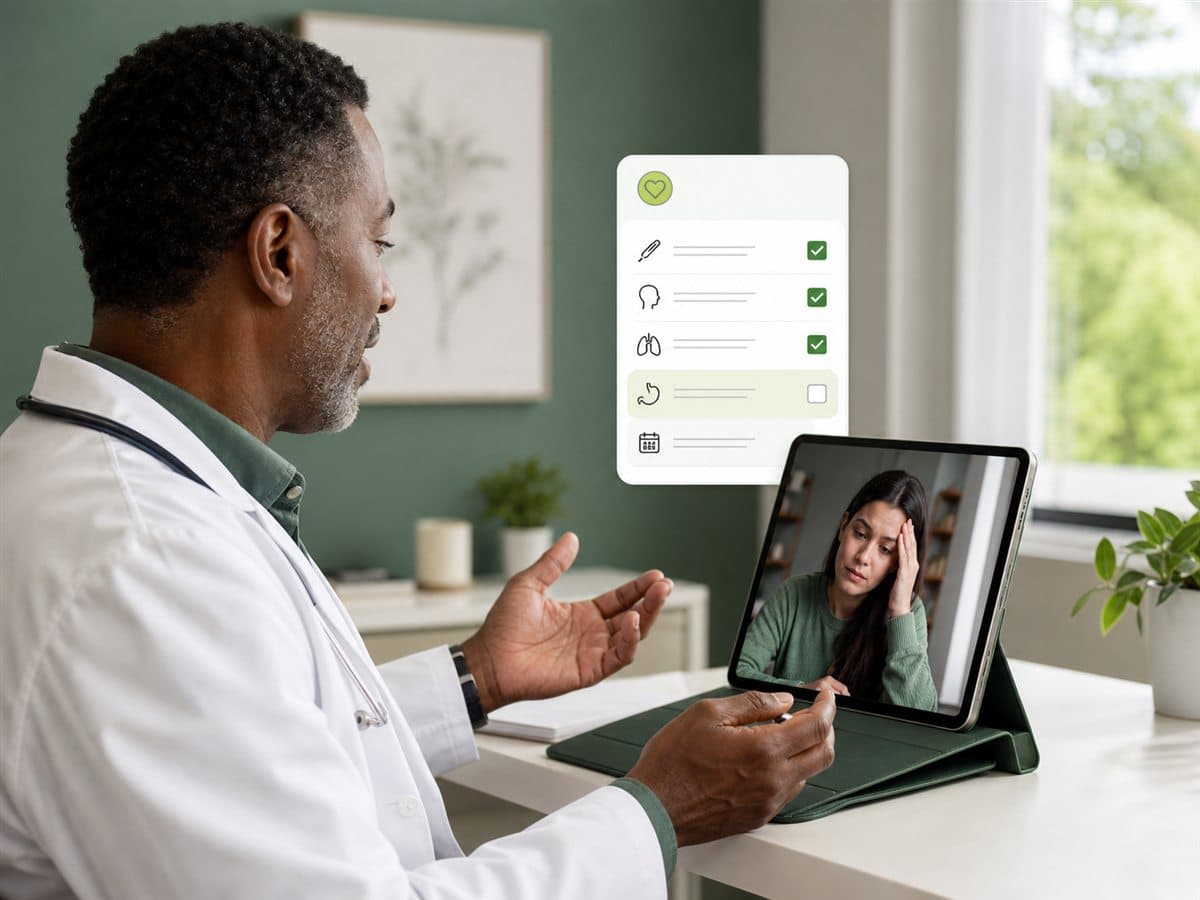
Online GP consultation
Talk any result through with a registered doctor by video, and get the checks a calculator cannot give you.

Free health tool
Answer a few questions about your sore throat to see how likely a bacterial cause is, and what the usual next step would be. It takes about a minute.
Your symptoms
A temperature over 38 °C, or feeling feverish and shivery, at any point since it started.
A cough points towards a virus, so the score counts its absence rather than its presence.
Just under the jaw on either side, sore when you press them — not the glands at the back of the neck.
Look with a torch at the back of the throat. This is hard to judge on yourself and is the weakest answer in the score.
Also drooling, a muffled voice, severe pain on one side only, or a stiff or swollen neck.
Often a fine, rough, sandpaper-like rash on the chest or neck.
Including chemotherapy, carbimazole, methotrexate or long-term steroids. A sore throat can be the first sign of a problem with your white blood cells.
Bacterial infection unlikely
This pattern is still much more often viral than bacterial. Self-care is usually right, but this is not a negative test — see a doctor if the pain worsens, a fever climbs, or you are no better after a week.
This estimates how likely a sore throat is to be bacterial. It is not a strep test and not a diagnosis — only a throat swab or an examination can confirm one. A low score means a bacterial infection is unlikely, not that it has been ruled out. Never start or stop antibiotics based on this page.
01
The score runs from -1 to 5. Four features each add a point — a fever, no cough, tender glands at the front of the neck, and white patches on the tonsils — and age adjusts the total up or down. Children aged 3 to 14 gain a point; adults over 45 lose one, because strep throat becomes uncommon with age.
The bands below describe how likely a bacterial cause is, not how bad the sore throat feels. A viral sore throat can hurt a great deal and still score zero.
0 or below
1
2
3
4 or 5
02
Each one is there because it shifts the odds between a virus and a bacterial infection, and together they do better than any single symptom on its own.
03
A score sorts likelihoods. It does not identify what is growing in your throat, and it was designed for a clinician who is looking at one.
04
These override the score completely. A serious throat infection can start out looking mild and score low, so none of the following should ever be weighed against a reassuring number.
Developed by Global Health using the methods and assumptions explained below. Established formulas and scales are credited to their original authors. McIsaac = one point each for fever, no cough, tender front-neck glands and tonsil swelling/white patches, plus age 3–14: +1, 15–44: 0, ≥45: −1. McIsaac et al. validated the clinical score. This tool suppresses the score under age 3 or when red flags require urgent assessment; self-reported examination findings limit accuracy. Score bands are ≤0, 1, 2, 3 and 4–5. Airway warnings take precedence, then rash or immunosuppression (same-day assessment), then age <3; all suppress the displayed score. These overrides are Global Health rules. The published fever criterion is >38 °C; this tool accepts self-reported fever or feeling feverish and self-assessed examination findings, so published clinical accuracy cannot be assumed.
Clinically reviewed by Dr Tiago Miguel Figueira· IMC 523449Last reviewed September 2026
A sore throat that scores high is a reason to be examined, not a diagnosis. These are the consultations that can take it further.
Talk any result through with a registered doctor by video, and get the checks a calculator cannot give you.
Body mass index from your height and weight, on the WHO adult scale.
Open calculatorHow many calories a day you need to maintain, lose or gain weight.
Open calculatorWhat your two numbers mean on the European adult blood pressure chart.
Open calculatorYour estimated due date, how far along you are, and the weeks that matter in between.
Open calculatorThe six-question adult ADHD screener, scored the way the scale is designed.
Open calculatorYour fertile window, your estimated ovulation day and when your next period is due.
Open calculatorWhich published risk factors for a fragility fracture apply to you, and whether it's worth asking for a bone density scan.
Open calculatorQuestions
No. A strep test is a swab of the throat, either sent to a laboratory or run as a rapid antigen test in the clinic. This page estimates how likely a bacterial cause is from your symptoms, which is what a clinician uses to decide whether that swab is worth taking. It cannot replace the swab.
Tonsillitis describes inflamed tonsils, whatever the cause — most often a virus. Strep throat is tonsillitis or pharyngitis caused by one particular bacterium, Streptococcus pyogenes, known as group A strep. Every case of strep throat is tonsillitis; most tonsillitis is not strep throat.
That is a decision for a doctor, not for this page. Most sore throats are viral, where antibiotics do nothing and still carry side effects. A high score means the odds of a bacterial cause are high enough that a doctor would usually examine you and consider testing — it does not mean antibiotics are indicated.
Most settle within about a week, whether viral or bacterial. A sore throat that is still worsening after a week, or that comes with a fever you cannot bring down, is worth having looked at regardless of what this checker says.
Because strep throat becomes uncommon with age. The original Centor score was built for adults and over-called bacterial infection in older patients; McIsaac's age adjustment corrects for that in both directions, adding a point for children aged 3 to 14, where strep is most common.
No. The scoring runs entirely in your browser. Nothing you select is sent to our servers or saved.
Yes. Antibiotics are prescription-only in Portugal, so a pharmacy cannot dispense them for a sore throat without one. A pharmacist can advise on pain relief and tell you whether they think you should be seen, but the prescribing decision belongs to a doctor who has examined you.
A family doctor can look at your throat and take a swab if the pattern warrants it. Emergency services are for the warning signs listed above, not for ordinary tonsillitis. Our registered doctors can review your symptoms by video consultation and advise whether a swab or an in-person examination is the right next step.
Book a video consultation with a registered doctor, go through your symptoms, and find out whether a swab, treatment or simple self-care is the right next step.