After diagnosis, monitoring and access to treatment help you manage the condition over the coming years.
A chronic disease is a long-lasting condition that is controlled over time and rarely cured: diabetes, high blood pressure, cardiovascular disease, asthma and COPD, endocrine disease, rheumatic disease, neurological disease, chronic kidney disease, cancer. For some of them (the serious and costly ones) Romania runs national health programmes through CNAS and the Ministry of Health, under which treatment is funded publicly. Inclusion is not requested at a counter: it starts with a diagnosis established by a specialist, who assesses whether you meet that programme's eligibility criteria.
Starting point
What a chronic disease means in practice
The textbook definition says «long-lasting». The useful definition says: it is not settled with a prescription, but with a relationship.
A chronic disease behaves differently from an infection. It has no ending, it has a trajectory. The outcome ten years from now depends far less on the moment of diagnosis than on what happens between reviews: whether treatment is actually taken, whether readings are tracked, whether complications arise and how quickly they are caught.
- Cardiovascular disease: hypertension, ischaemic heart disease, heart failure.
- Metabolic and endocrine disease: diabetes, thyroid disease, other endocrine conditions.
- Respiratory disease: asthma, COPD.
- Neurological disease: epilepsy, multiple sclerosis, Parkinson's disease.
- Cancer, chronic kidney disease, rheumatic disease and rare diseases.
Many of these conditions have long periods without symptoms. Treatment may seem unnecessary during these months, and patients may stop attending follow-up appointments.
The framework
What the national health programmes are
They are the mechanisms through which the state funds treatment for serious conditions, beyond the ordinary package of services.
CNAS runs the curative national health programmes (the treatment of patients themselves) while the Ministry of Health runs public health programmes oriented towards prevention, screening and prophylaxis. Each institution publishes its own list and updates it, so the reference stays the official page, not an article.
- The national cardiovascular disease programme.
- The national diabetes programme.
- The national oncology programme.
- The national endocrine disease programme.
- The national orthopaedics programme.
- The national treatment programme for rare diseases.
- The national transplant programme for organs, tissues and cells.
Each programme has its own eligibility criteria, its own therapeutic protocols and its own list of units that run it. Having the diagnosis does not automatically mean you meet a programme's criteria: those are defined clinically, through norms.
Official lists: CNAS: curative programmes · Ministry of Health: national programmes.
The pathway
How inclusion in a programme happens
The pathway is always clinical first and administrative afterwards, never the other way round.
- Assessment by a specialist, with the investigations the condition's protocol requires.
- A definite diagnosis, documented: not a suspicion, but a diagnosis supported by results.
- Checking the programme's eligibility criteria, done by the treating doctor.
- The documents attesting inclusion, on the basis of which treatment is dispensed.
- Periodic reassessment: staying in the programme depends on continuing to meet the criteria and on monitoring.
The treating doctor in the unit running the programme is the person who leads this process. Your family doctor has an essential but different role: following you between reviews, continuing prescriptions where the law allows on the basis of the medical letter, and being the first to notice signs of deterioration.
A different mechanism
Subsidised medicines are not the same thing
Confusing «national programme» with «subsidised medicines» sends people to the wrong counter every week.
They are two distinct mechanisms. National programmes fund treatment for serious conditions, generally through the units that run the programme. Separately, there is the list of conditions for which insured people receive subsidised or free medicines in outpatient care, dispensed on a prescription from a family doctor or specialist, under conditions set by norms.
- Do not assume from the diagnosis which mechanism applies to you: ask your treating doctor, who knows the condition's protocol.
- The lists and the subsidy percentages are set by legislation and change.
- A subsidised prescription is issued by doctors in a contractual relationship with the health insurance house.
Lists and conditions in force: CNAS.
Between reviews
What happens between reviews
This is where a chronic disease is won or lost, and it is where the system is thinnest.
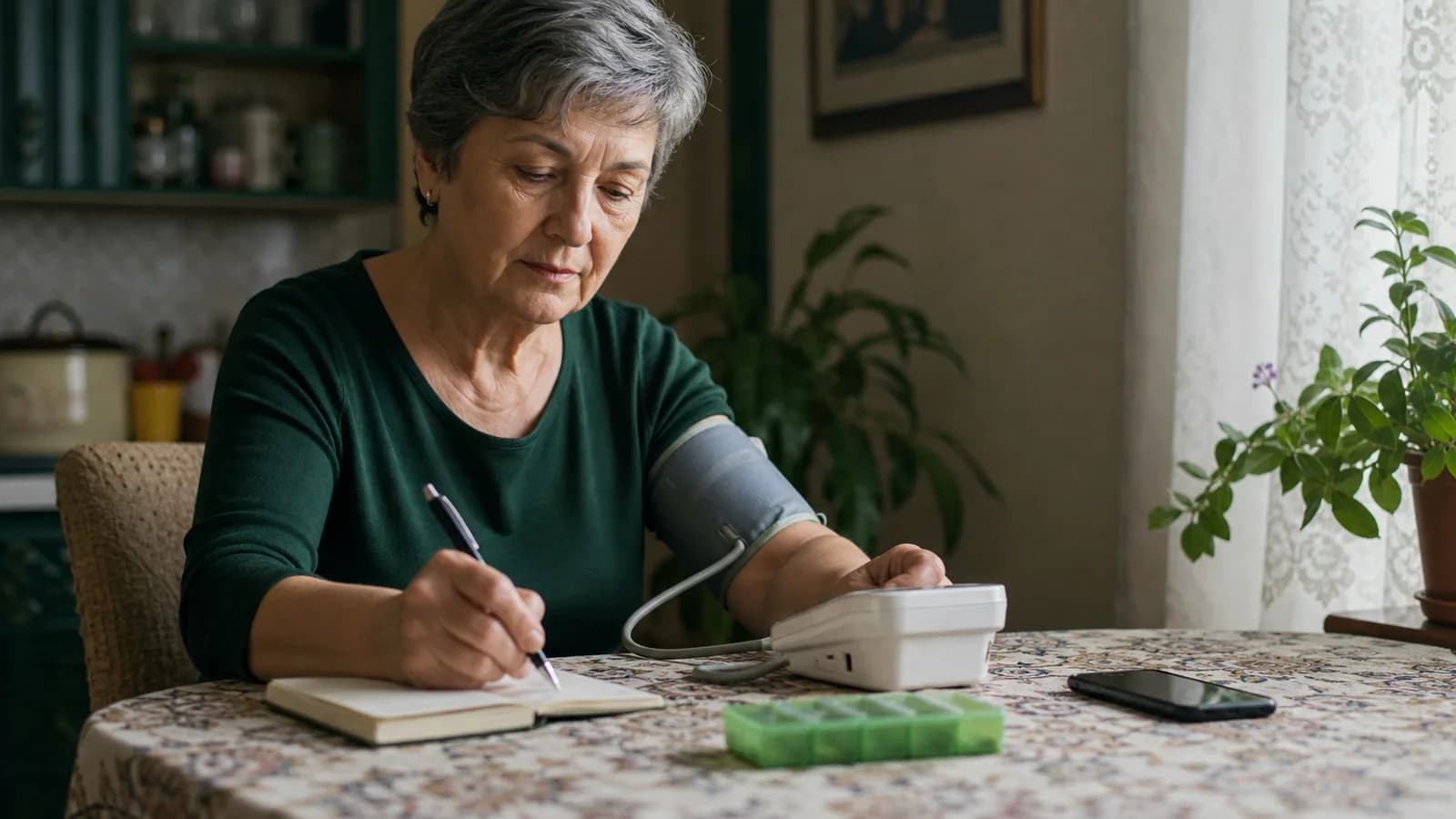
Specialist reviews happen rarely. The disease, by contrast, moves every day. The difference between a patient who reaches complications and one who does not is almost always what happened in the months between appointments: whether the treatment was taken, whether readings were measured and recorded, whether a new symptom was reported in time or ignored.
- Measure and record what your condition calls for: blood pressure, blood sugar, weight, pulse, symptoms.
- Bring the data to the review, not just a general impression. A notebook or an app is worth as much as a consultation.
- Report side effects instead of stopping treatment on your own: silent discontinuation is the commonest cause of decompensation.
- Vaccinations recommended in chronic disease are a discussion for your treating doctor.
- Lifestyle (sleep, movement, diet, smoking, alcohol) shifts the trajectory more than most patients imagine.
Transparency
What an online consultation can and cannot do
Check what a private consultation can provide before booking.
A private provider does not include patients in the national health programmes and does not issue reimbursed documents from the insurance fund: no subsidised prescription, no referral note. Those belong to doctors in a contractual relationship with the health insurance house.
What an online consultation does cover is precisely the part most often missing from chronic care:
- Regular monitoring between specialist reviews, using the readings you take at home.
- Explaining results and treatment: why each medicine, what to watch, what to report.
- Assessing a new symptom without waiting for the next appointment.
- A second opinion before an important decision.
- Preparing the file: which documents you are missing and from whom to obtain them.
- Support for lifestyle change, followed over time rather than discussed once.
You can check any doctor's registration with the Romanian College of Physicians, ours as readily as anyone else's.
Safety
When not to wait for the next appointment
A well-controlled chronic disease can turn acute within hours.
- Chest pain or pressure, especially with sweating, breathlessness, or pain spreading to the arm or jaw.
- Sudden weakness on one side of the body, a drooping face, difficulty speaking, or a sudden severe headache.
- Breathlessness at rest, or blue lips and face.
- Very high or very low blood sugar with confusion, vomiting or drowsiness.
- Rapid swelling of the legs with a sudden gain in weight, in a patient with heart disease.
- Fever with chills in someone immunosuppressed or on cancer treatment.
In any of these situations call 112. Documents, programmes and files can be discussed after the emergency has been addressed.
Global Health Romania
Next steps
Our doctors in Romania follow you between specialist reviews and tell you plainly what can be settled privately and what stays within the insurance pathway.
Living with a chronic condition and rarely seeing your doctor?
A monitoring consultation reviews the readings you take at home, how you are getting on with treatment and any new symptoms and prepares you for the next specialist review.
Official sources
Where to check the rules
Programme lists, eligibility criteria and subsidy conditions are set by norms and change. Always check at source.
Links open the competent bodies' own websites. Global Health is a private provider, does not include patients in the national health programmes and does not issue documents reimbursed from the social health insurance fund.
FAQ
Common questions
Which diseases are covered by the national health programmes?
CNAS runs curative programmes for serious conditions (among them cardiovascular disease, diabetes, oncology, endocrine disease, orthopaedics, rare diseases and transplant) while the Ministry of Health runs public health programmes. The list is updated by norms, so the reference is the official CNAS page rather than an article.
How do I get included in a national health programme?
Through assessment by a specialist with the investigations the protocol requires, a documented definite diagnosis, and verification of the programme's eligibility criteria by the treating doctor in the unit that runs it. Staying in the programme depends on periodic reassessment.
What is the difference between a national programme and subsidised medicines?
They are different mechanisms. National programmes fund treatment for serious conditions, generally through the units running the programme. Separately there is the list of conditions for which insured people receive subsidised or free medicines in outpatient care, on a prescription issued under conditions set by norms.
What does chronic disease mean?
A long-lasting condition that is controlled over time and rarely cured: diabetes, hypertension, asthma and COPD, endocrine disease, neurological disease, chronic kidney disease, cancer and others. What decides the course is not the moment of diagnosis but the monitoring between reviews.
Does a chronic disease entitle me to retire on medical grounds?
That is a separate procedure decided by the pension system on the basis of a work capacity assessment: not by inclusion in a national health programme and not by your treating doctor. The conditions change, so ask the pension house directly.
Can I be monitored online for a chronic condition?
Yes, for monitoring, explaining treatment, assessing a new symptom, a second opinion and preparing your file. Inclusion in programmes and reimbursed documents, such as the subsidised prescription and the referral note, remain with doctors contracted to the health insurance house.