Influenza A: symptoms, how long it lasts and when to seek care
How to recognise the flu, how long you are contagious, which warning signs cannot wait and who should get the flu vaccine before the Christmas gatherings.
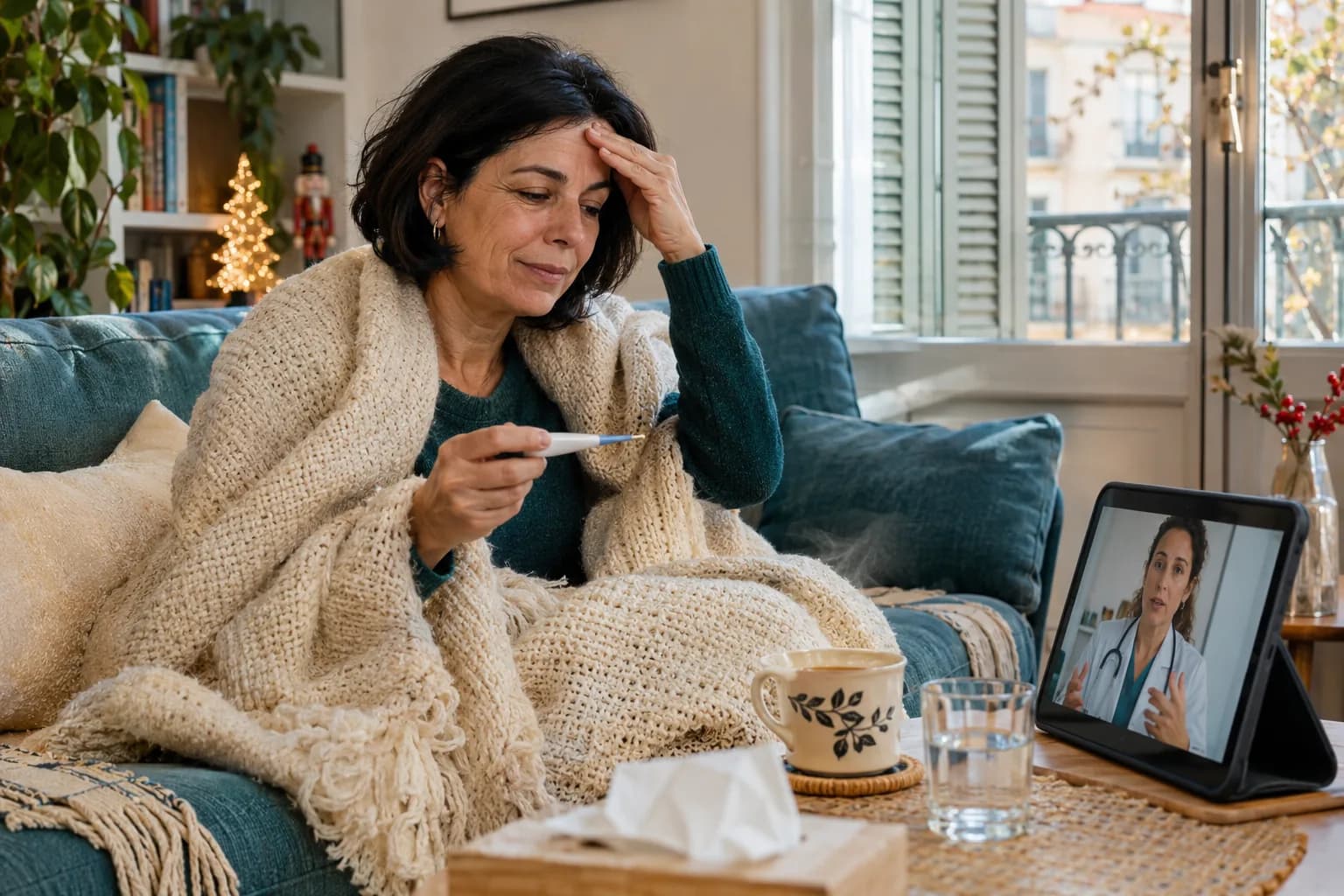
Influenza A causes symptoms such as fever, headache and muscle aches, chills, a runny nose, sore throat, a dry cough and marked tiredness. According to the Spanish Ministry of Health, symptoms usually last about a week, although the cough can continue for more than two. An adult is contagious from a day before symptoms appear until 3 to 7 days afterwards. Most people recover at home, but older people, pregnant women and people with chronic conditions are at higher risk of complications. If you get worse after having improved, seek care without waiting.
Symptoms
Influenza A: the most common symptoms
Influenza is an infection caused by the influenza virus that mainly affects the airways. Types A and B are the most common, and influenza A causes the same symptoms as the flu in general.
The Spanish Ministry of Health lists these main symptoms:
- Fever and chills
- Headache and muscle aches
- A runny nose and sore throat
- Dry cough
- Weakness and intense tiredness
Children may also have vomiting and diarrhoea, which are uncommon in adults. In older people, the first sign may be that an existing condition gets worse, such as chronic bronchitis or heart failure, sometimes without fever.
Only a diagnostic test can tell influenza apart from other respiratory viruses with certainty. Based on your symptoms, your doctor can guide the diagnosis and decide whether it needs to be confirmed.
Virus types
Influenza A and influenza B: what is different
For you, the practical difference is small: the symptoms and the care are the same. What changes is which virus dominates each winter.
According to the Ministry of Health recommendations for this season, last winter (2025-2026) was dominated by influenza A, specifically the subclade K of A(H3N2), which spread quickly around the world. That season had fewer cases than the previous one but was more severe: an estimated 1.4 million cases of respiratory infection due to influenza, 46,000 hospital admissions, 2,000 ICU admissions and 3,400 deaths in Spain. In the 2024-2025 season, with influenza A and B circulating together, there were 1.7 million cases and 39,500 hospital admissions.
Vaccines change every year to keep up with the viruses. Those for the 2026-2027 season are trivalent and include two influenza A strains (H1N1 and H3N2) and one influenza B strain of the Victoria lineage, all updated from last year.
Source: Ministry of Health, influenza vaccination recommendations 2026-2027, with data from SiVIRA (Instituto de Salud Carlos III), provisional up to week 18/2026.
Duration
How long the flu lasts and when it is contagious
Flu symptoms appear about 2 days after infection (between 1 and 4), last 5 to 7 days, and the cough can continue for more than two weeks.
| Stage | Approximate duration |
|---|---|
| Incubation (from infection to symptoms) | 2 days, between 1 and 4 |
| Symptoms | 5 to 7 days, about a week |
| Cough | Can last more than 2 weeks |
| Contagious period in adults | From 1 day before symptoms until 3-7 days afterwards |
| Contagious period in children | Can exceed 7 days |
A cough that lasts a few days longer does not by itself mean there is a complication. What does call for a consultation is a fever that returns after you had improved, or difficulty breathing.
The virus spreads through the droplets we release when coughing, sneezing or talking, and also by touching your mouth, nose or eyes after touching contaminated surfaces.
Sources: Ministry of Health, influenza (professionals); Ministry of Health, influenza (public information).
Surveillance in Spain
How the flu is doing this autumn
The Acute Respiratory Infection Surveillance System (SiVIRA), run by the Instituto de Salud Carlos III, publishes primary care and hospital data every week.
In week 44/2026 (25 October to 1 November), the influenza positivity rate in primary care samples was 6.4 %, double that of the previous week (3.2 %). The estimated incidence of influenza rose from 13.4 to 27.7 cases per 100,000 inhabitants. Acute respiratory infections as a whole passed the epidemic threshold in week 39/2026, at low intensity; in that same week 44, SARS-CoV-2 was still ahead of influenza.
In other words: in early November the flu was starting to rise, still far from peak levels. Last season the epidemic period ran from week 47/2025 to week 3/2026, with the peak in week 50, just before Christmas.
Sources: SiVIRA, weekly report 44/2026; Ministry of Health, recommendations 2026-2027.
When to seek care
Warning signs and who is at higher risk
The most common complications are respiratory infections, such as pneumonia, as well as ear infections, sinusitis and the worsening of chronic conditions.
According to the Ministry of Health, those at higher risk of complications are premature babies up to 24 months, older people, pregnant women, people with chronic conditions and people with weakened immune systems. If you are in one of these groups, seek care early even if your symptoms seem mild.
Book a consultation if the fever does not go down or comes back after you had improved, if the cough gets worse or you bring up coloured phlegm, if a chronic condition becomes unstable or if you cannot drink enough.
Sources: Ministry of Health, influenza (professionals); Ministry of Health, influenza (public information).
Care at home
How the flu is treated
In most people, the flu is treated at home: rest, fluids and medicines for fever and pain.
- Rest and drink fluids often, especially if you have a fever.
- Take only the fever reducers and painkillers your doctor has recommended, within the stated dose.
- Stay at home while you have a fever so you do not infect others.
- If you cough or sneeze, do it into your elbow or a disposable tissue, and wash your hands often.
Antibiotics do not cure the flu. The AEMPS reminds us that they only work against bacteria, not against viruses such as the flu or the common cold, and that taking them unnecessarily helps bacteria become resistant. Your doctor prescribes them only if a bacterial complication, such as pneumonia, is suspected.
Antivirals for the flu exist and need a prescription. According to their package leaflet, treatment should start as soon as possible, ideally within the first two days after symptoms begin. They are not a vaccine and are not suitable for everyone: your doctor assesses whether they are right for you, especially if you are at higher risk of complications.
Sources: AEMPS, antibiotics are not effective against the flu; AEMPS (CIMA), package leaflet of a flu antiviral; Ministry of Health, questions and answers 2026-2027.
Prevention
Flu vaccine: who should get it
Vaccination is the most effective measure for preventing the flu and its complications. In Spain it is recommended for the groups at higher risk and for those who live with them.
For the 2026-2027 season, the Ministry of Health recommends the flu vaccine for these groups, among others:
- People aged 60 or over.
- Children aged 6 to 59 months.
- People aged 5 to 59 with risk conditions: diabetes, morbid obesity, chronic heart, lung (including asthma), kidney, liver or nervous system disease, immunosuppression, cancer, coeliac disease or chronic inflammatory disease, among others. Also smokers.
- Pregnant women, in any trimester, or within 6 months after delivery if they were not vaccinated.
- Those who care for or live with people at risk, including people living with babies under 6 months.
- Healthcare and social care staff, workers in essential services and in nurseries, and people who work with farm animals or wildlife.
For people outside these groups, the Ministry considers that, given the current situation, vaccination is not justified. The vaccine is not mandatory.
What is worth knowing
- Optimal protection comes about two weeks after the vaccine, and the vaccine is available until the season ends.
- Inactivated vaccines contain no live virus and cannot cause the flu.
- The most common reactions are pain or swelling in the arm, fever, general discomfort or muscle pain, and they do not last more than 48 hours.
- You can have the flu vaccine and the COVID-19 vaccine on the same day if you are eligible for both.
- If you have a fever or an acute infection, the vaccine is postponed until your symptoms have passed.
- An egg allergy does not prevent vaccination. It is contraindicated in babies under 6 months and after a severe allergic reaction to a previous dose.
If you are not sure whether you belong to a risk group, our doctor can review your history in a video consultation and tell you whether the vaccine is indicated for you.
Sources: Ministry of Health, recommendations 2026-2027; Ministry of Health, questions and answers 2026-2027.
Holidays and travel
Flu at Christmas: visits, travel and family meals
The holidays bring several generations to the same table in the middle of flu season. Last winter the peak came in mid-December (week 50/2025); the winter before, at the end of January. A few decisions made in time protect the most vulnerable.
- If you are due a vaccine, get it as soon as possible. Protection takes about two weeks to reach its maximum: a vaccine given in mid-December will not yet have reached full protection on Christmas Eve.
- If you have a fever, do not go to the meal. An adult is contagious from a day before symptoms until 3 to 7 days afterwards, and a child can be contagious for more than a week.
- Protect grandparents and babies. If you have respiratory symptoms and cannot avoid the gathering, wear a mask, ventilate the room and avoid close contact with older people, pregnant women and babies under 6 months.
- Before a long journey, bear in mind that the flu can begin halfway there. Bring your usual medication and a report on your chronic conditions.
- Wash your hands often and do not reuse tissues.
If you fall ill away from home during the holidays, you can have a video consultation without travelling.
Sources: Ministry of Health, questions and answers 2026-2027; Ministry of Health, influenza (public information); recommendations 2026-2027.
Global Health
Online medical consultation for the flu
With the flu, the last thing you want is to leave the house. In our online medical consultation, a doctor registered in Spain sees you by video call, with a same-day appointment subject to availability.
- Assessment. Reviews your symptoms, when they started, your age, your conditions and your medication.
- Warning signs. Identifies what cannot wait and tells you what to do.
- Treatment. If clinically indicated, can issue a private electronic prescription, including antibiotics when there is a bacterial complication.
- Medical note. If you need to justify an absence, can issue a private medical certificate when clinically indicated. It is not a sick-leave certificate.
- Follow-up and referral. Can request tests and, if needed, refer you to a specialist.
- Vaccine. Clarifies whether you belong to a group for which the flu vaccine is recommended.
A video consultation does not allow the doctor to listen to your chest or measure the oxygen in your blood: if your case needs a physical examination, the doctor will tell you and explain how to arrange it.
Next step
Talk to a doctor about your flu
Book your online medical consultation or get to know our doctors first.
Fever, cough and feeling unwell?
Book your online medical consultation with a doctor registered in Spain: video assessment, warning signs and treatment when indicated.
Sources
Sources and editorial review
Sources consulted and checked on 8 November 2026.
Data on symptoms, duration and contagiousness come from the Ministry of Health; season figures from SiVIRA (Instituto de Salud Carlos III), those for 2025-2026 being provisional; vaccination groups from the official 2026-2027 recommendations; and information on antibiotics and antivirals from the AEMPS. This article does not replace your doctor's assessment.
Frequently asked questions
Questions about influenza A
Influenza A: which symptoms appear first?
They are usually fever, chills, headache and muscle aches, followed by a dry cough, runny nose, sore throat and tiredness. In older people, the first sign is sometimes that a pre-existing condition gets worse.
How long does influenza A last?
Symptoms last 5 to 7 days, about a week. The cough can continue for more than two weeks. If the fever returns after improving, seek care.
How many days is the flu contagious?
An adult is contagious from a day before noticing symptoms until 3 to 7 days afterwards. Children can be contagious for more than 7 days.
Should I get the flu vaccine if I have no risk factors?
The Ministry of Health recommends it for people over 60, children aged 6 to 59 months, pregnant women, people with risk conditions, smokers, people living with those at risk and some workers. Outside those groups, it considers that it is not currently justified.
Do antibiotics work for the flu?
No. The flu is caused by a virus and antibiotics only work against bacteria. Your doctor prescribes them only if there is a bacterial complication, such as pneumonia.
Can I consult about the flu by video call?
Yes. In our online medical consultation, a doctor registered in Spain assesses your symptoms, detects warning signs and, if indicated, prescribes a treatment. If you need a physical examination, the doctor will tell you.