Gout: a joint disease, symptoms, treatment and diet over the holidays
Why gout starts in the big toe, what triggers an attack, how to manage it quickly and how to avoid it during Christmas feasting.
Gout is an inflammatory joint disease in which uric acid crystals build up in the joints. It usually begins with a sudden attack of severe pain, swelling and redness, most often in the big toe. It affects about 1 to 2% of people. An attack is often triggered by a rich meal and alcohol, which is why gout makes itself known at Christmas too. Treatment of an attack should start as soon as possible, ideally within 24 hours. Long-term treatment lowers uric acid and prevents further attacks.
Definition
Gout: a joint disease caused by uric acid
Gout is the most common crystal arthritis. It develops when crystals of monosodium urate build up in the joints and soft tissues.
Gout is caused by a long-term raised level of uric acid in the blood, known medically as hyperuricaemia. This can go on for years without symptoms. When crystals start to settle in a joint, the body reacts to them with sudden inflammation. That is a gout attack.
Untreated gout comes back and can damage the joints and the kidneys. Over time, lumps made of crystals, called tophi, may appear around the joints and on the ears.
Sources: M. Olejárová: Gouty arthritis, Medicína pro praxi 2011; NZIP, Obesity and gout; VZP, Treatment of gouty arthritis.
Symptoms
What a gout attack looks like
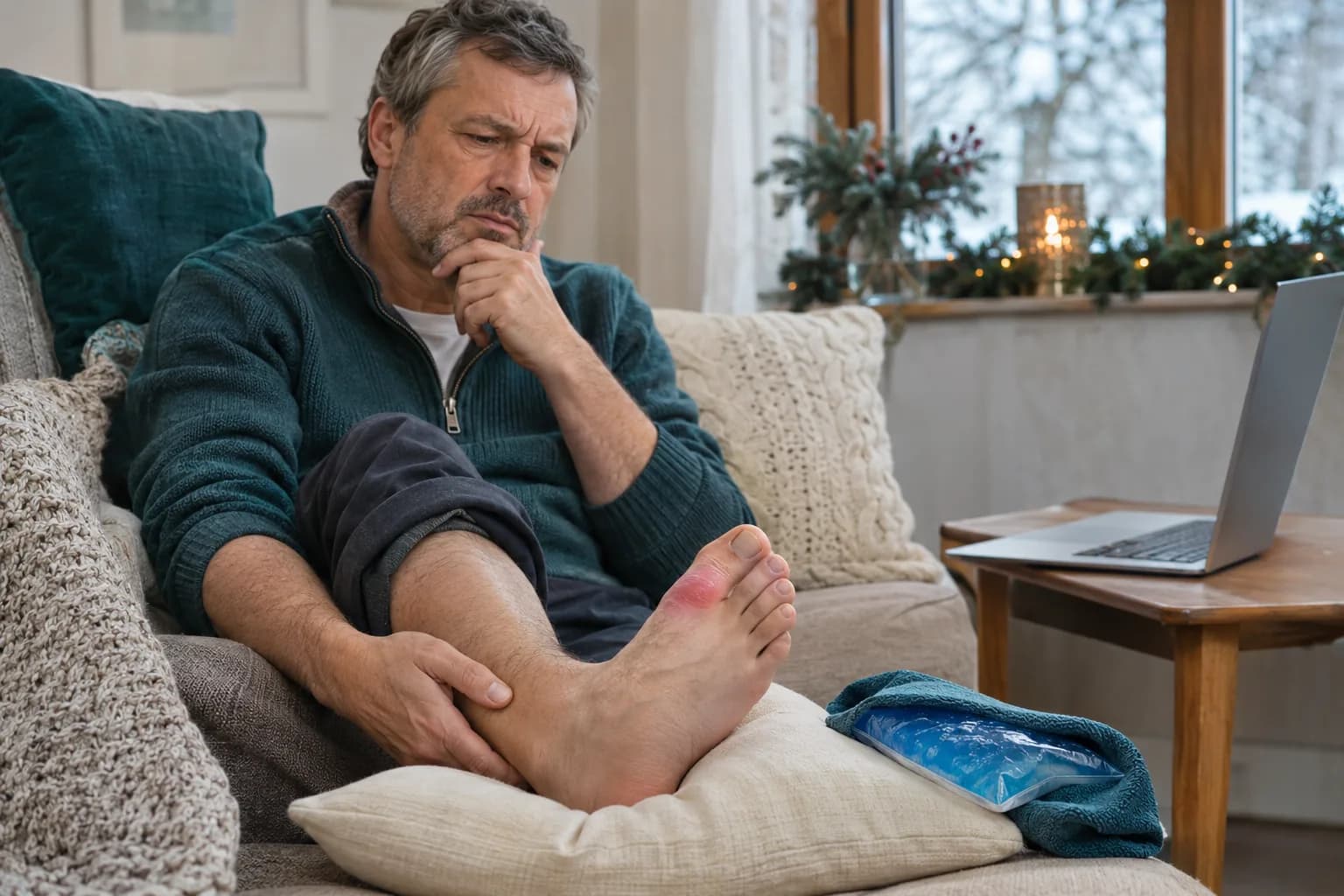
A gout attack comes on quickly. Pain, swelling, redness and tenderness of the joint usually peak within 6 to 12 hours.
- The big toe. The first joint affected is most often the joint at the base of the big toe. This pattern is called podagra.
- Other joints. Gout can also affect the ankle, the knee or other joints, and in older people more often the joints of the hands as well.
- Severe pain and tenderness. The joint hurts when touched and also at rest.
- Redness and swelling. The joint is swollen and the skin over it is red.
Classic podagra is more common in middle-aged men. In people over 70, gout tends to be less typical and may affect several joints at once.
Sources: K. Pavelka: Diagnosis and therapy of gout, Vnitřní lékařství 2015;61(6):517–526; NZIP, Obesity and gout.
Risk factors
Who is at risk of gout
About 1 to 2% of the population have gout. It becomes more common with age: up to 7% of men over 65 and over 3% of women over 85.
- Men. They develop gout more often than women.
- Overweight and metabolic syndrome. Obesity is one of the risk factors for gout.
- High blood pressure, type 2 diabetes and kidney disease. These are linked to raised uric acid.
- Some medicines. For example, diuretics (water tablets) can raise the uric acid level. Never stop them on your own, though; talk to a doctor.
- Heredity and lifestyle. Uric acid levels are influenced by both genes and diet.
A raised uric acid level is usually taken to be more than 400 μmol/l in men and more than 360 μmol/l in women. A high level on its own neither confirms nor rules out gout. Many people with a high level never develop gout.
Sources: K. Pavelka, Vnitřní lékařství 2015; NZIP, Obesity and gout; VZP, Treatment of gouty arthritis.
Holidays
Why gout strikes at Christmas
The Czech Medical Society of J. E. Purkyně points out that a gout attack typically follows an excess of food or alcohol. December offers plenty of both.
- Beer and other alcohol. Alcohol is a typical cause of gout, beer most of all, but also wine and spirits.
- Cured meats and roast meat. The most common sources of purines include cured meats, fried and grilled meat and the meat of young animals.
- Offal and game. Liver, kidneys, game and meat broths contain a lot of purines.
- Sweetened drinks, biscuits and desserts. Fructose reduces the breakdown of uric acid in the body.
- Too little fluid. Drinking too little has a negative effect on gout. At a party, alternate alcohol with water.
Simpler rules for the holidays: meat ideally once a day and in a smaller portion, vegetables with your meal, drink mainly water and be careful with beer. If you already have gout and take medicines, keep taking them regularly over the holidays too.
Sources: NZIP (ČLS JEP), Diet in gout and hyperuricaemia; NZIP (ČLS JEP), Obesity and gout; K. Pavelka, Vnitřní lékařství 2015, table 8.
When to act at once
A hot, swollen joint and fever: it may not be gout
Sudden joint inflammation can look like gout, but it can also be a bacterial infection of the joint, known as septic arthritis. Gout and infection can also occur at the same time.
For this reason, when joint inflammation is unclear, doctors examine the joint fluid and send it for culture, even if they find crystals in it. A joint infection must also be ruled out before a corticosteroid is injected into a joint.
Source: K. Pavelka, Vnitřní lékařství 2015, EULAR recommendations for the diagnosis of gout.
First aid
What to do during a gout attack
In a gout attack, starting treatment quickly matters more than the choice of a particular medicine. Treatment should start within 24 hours of the start of the attack.
- Rest. Spare the joint and do not put weight on it.
- Cold. A cold compress or an ice pack over a cloth helps.
- Anti-inflammatory medicines. Non-steroidal anti-inflammatory drugs, colchicine or corticosteroids are used. The choice depends on your health, your kidneys and your other medicines, so leave it to the doctor.
- Change nothing in long-term treatment. If you already take a medicine to lower uric acid, do not stop it during an attack. The doctor starts new treatment only after the inflammation has settled.
Anti-inflammatory medicines work better when you start them early. It is therefore worth contacting a doctor on the very first day of an attack.
Sources: K. Pavelka, Vnitřní lékařství 2015; M. Olejárová, Medicína pro praxi 2011; EULAR 2016, recommendations for the management of gout.
Tests
How gout is confirmed
With a typical attack in the big toe and a raised uric acid level, gout is likely. Certainty comes only from finding the crystals.
- Conversation and joint examination. The doctor asks about the course of the attacks, your medicines, your diet and alcohol.
- Blood tests. The uric acid level and markers of inflammation are only supportive. During an attack, uric acid can even be normal.
- Joint fluid. Uric acid crystals seen under the microscope confirm gout with certainty.
- Ultrasound or X-ray. They help to assess the joint and the changes in long-standing gout.
The doctor also looks for conditions linked to gout: high blood pressure, obesity, diabetes and kidney problems.
Sources: K. Pavelka, Vnitřní lékařství 2015; VZP, Treatment of gouty arthritis.
Preventing attacks
Long-term treatment of gout and the target level
The aim of long-term treatment is to bring uric acid permanently below 360 μmol/l. Below this level crystals stop forming and gradually dissolve.
- When to start. The European League Against Rheumatism, EULAR, recommends considering uric-acid-lowering treatment from the first sign of the disease.
- Target. Below 360 μmol/l, and below 300 μmol/l in severe gout.
- Medicines. The first-choice medicine is allopurinol. The dose is raised gradually and adjusted to kidney function. If the effect is not enough, other medicines are possible.
- Protection at the start. When treatment begins, attacks may temporarily become more frequent, so the doctor usually adds a protective medicine.
- Check-ups. The uric acid level is checked regularly until the target is reached, and then afterwards as well.
Do not take uric-acid-lowering medicines only when you are in pain. They work when you take them long term and regularly.
Sources: P. Richette et al.: 2016 updated EULAR evidence-based recommendations for the management of gout, Ann Rheum Dis 2017;76:29–42; K. Pavelka, Vnitřní lékařství 2015.
Menu
Diet in gout: what to avoid and what to limit
Diet alone does not cure gout, but it lowers uric acid and the risk of attacks. It also improves blood pressure, weight and diabetes, which are linked to gout.
| Avoid | Limit | Recommended |
|---|---|---|
| Offal: liver, kidneys, sweetbread | Beef, pork and lamb in smaller portions | Low-fat dairy products |
| Sweetened drinks with fructose | Sardines, mussels and other purine-rich seafood | Vegetables |
| Excess alcohol; none at all if attacks are frequent | Fruit juices, sugar, sweets and desserts, salt; alcohol, especially beer, but also wine and spirits | Plenty of water |
- Weight loss. Losing weight when overweight helps to prevent attacks.
- Exercise and not smoking. Regular exercise and giving up smoking improve overall health.
- Fluids. Drink enough unsweetened fluids.
Sources: K. Pavelka, Vnitřní lékařství 2015, table 8 based on ACR; NZIP, Diet in gout and hyperuricaemia; VZP, Treatment of gouty arthritis.
Video consultation
How an online consultation with a doctor helps
With a swollen big toe, getting to a surgery is hard. In a video consultation the doctor assesses your problem from home and suggests the next steps.
- Assessing the joint. The doctor asks how the problem started and developed and asks you to show the joint to the camera.
- Warning signs. The doctor asks specifically about fever, injury and other symptoms that need an immediate in-person examination.
- Treatment. If it is clinically indicated, the doctor issues an electronic prescription.
- Imaging. When needed, the doctor issues a request for, for example, an ultrasound or an X-ray.
- Rheumatologist. For inflammatory arthritis, the doctor assesses your problem and refers you to a rheumatologist. The referral is issued on the same day as the consultation.
- Follow-up. You can go through the test results at a follow-up consultation.
Taking joint fluid and finding crystals cannot be done online, however. If your problem needs an in-person examination, the doctor will tell you so openly and recommend the next steps.
Prepare a list of your medicines, the results of earlier blood tests and a photo of the joint. Book an online consultation for musculoskeletal pain.
Care in Czechia
Talk to a doctor online
Do you have sudden pain in your big toe or another joint and are not sure whether it is gout? Have a doctor assess it from home.
Sudden pain in your big toe or another joint?
In a video consultation the doctor assesses your problem and the warning signs, suggests treatment and, as needed, issues an electronic prescription, a request for tests or a referral to a rheumatologist.
Sources
Professional sources for this article
Sources verified on 8 November 2026.
This article is based on Czech professional sources (Vnitřní lékařství, Medicína pro praxi, NZIP with texts of the Czech Medical Society, VZP) and on the recommendations of the European League Against Rheumatism, EULAR, verified on 8 November 2026. The article does not give medicine doses.
Frequently asked questions
Frequently asked questions about gout
Is gout a lifelong disease?
If you keep uric acid below the target level in the long term, crystals gradually dissolve and attacks can stop completely. This is why regular treatment matters, not just relieving the pain.
Can I drink beer if I have gout?
Beer is particularly risky for gout, but wine and spirits also need to be limited. With frequent attacks or poorly controlled gout, it is recommended to avoid alcohol completely. Otherwise cut it down sharply and drink water with it.
How quickly should I deal with a gout attack?
As soon as possible. Treatment should start within 24 hours of the start of the attack, and speed matters more than the choice of medicine. In the meantime, rest and cool the joint.
Is diet alone enough for gout?
Diet mainly helps to prevent attacks and improves overall health. However, the EULAR recommendations advise considering a uric-acid-lowering medicine from the first sign of gout. A doctor decides whether you need one.
Can gout be dealt with online?
Yes, as a first step. In a video consultation the doctor assesses the problem and the warning signs and can issue an electronic prescription, a request for imaging and a referral to a rheumatologist. Taking joint fluid requires an in-person examination.