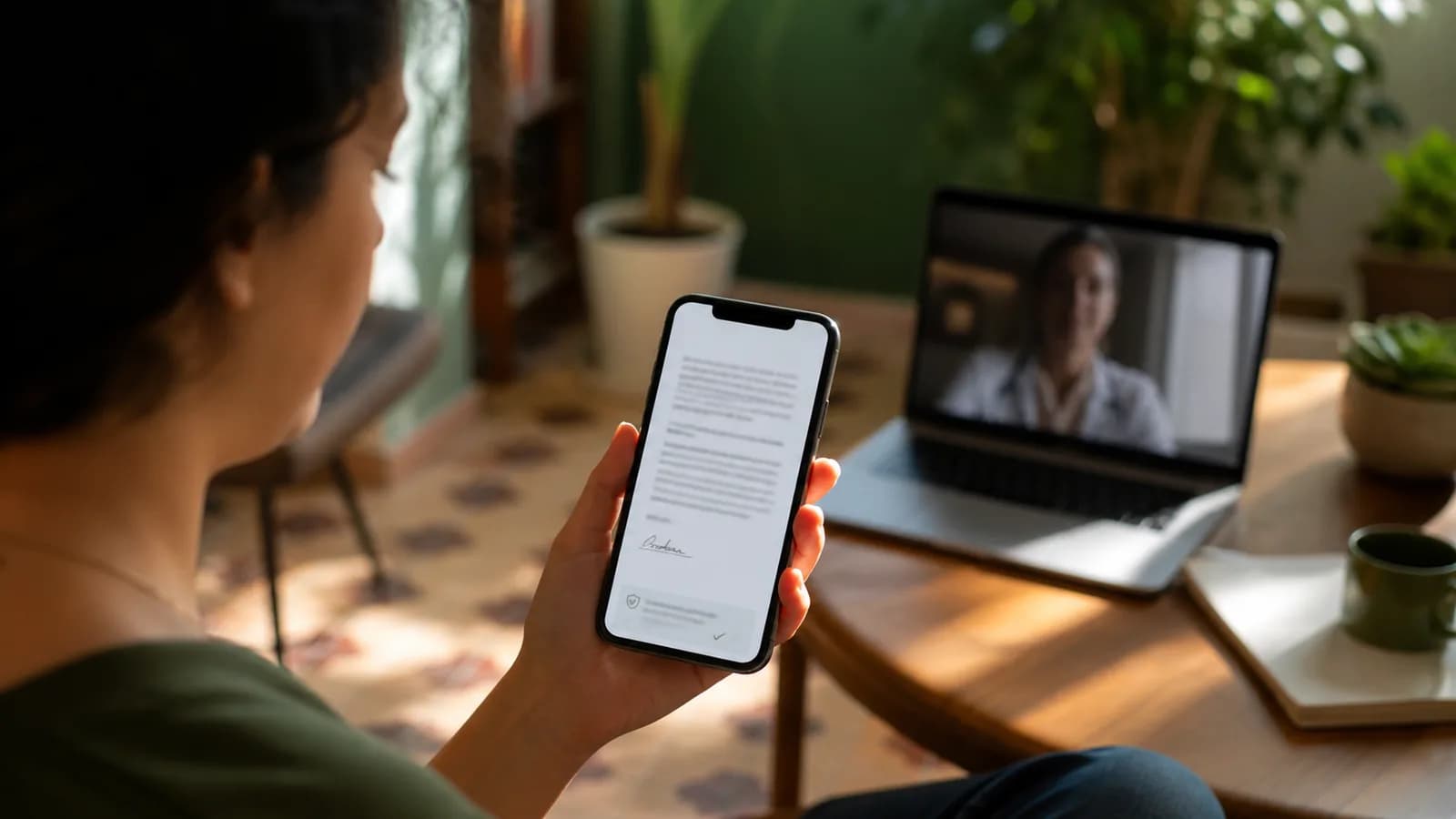

A test is only useful when somebody knows what they will do with the result. That is what the medical request documents.
The test request is the document in which a doctor records which tests should be done and why. It can be issued on paper or as a PDF with a digital signature, accepted by laboratories in the same way — the Federal Council of Medicine runs its own platform for exactly this. The request serves three purposes at once: telling the laboratory what to collect, giving the health plan the clinical indication where one is required, and ensuring there is a doctor responsible for interpreting the result. Some routine tests can be arranged directly at a private laboratory, but that settles the collection, not the interpretation.
Starting point
What the medical request is for
The question that matters is not «which tests should I have», but «which question do these tests answer».
Every test has a range of normal results built from a population. That means that in any large panel run on a healthy person, it is statistically expected that something will come back slightly outside the range. Without a clinical question behind it, that finding is not information: it is a fright, and it usually generates further tests, further appointments and sometimes procedures that would not have been necessary.
- It tells the laboratory exactly what to collect and under what conditions.
- It records the clinical indication, which health plans generally require in order to authorise.
- It establishes who interprets the result — and who answers for it.
- It avoids repeating tests done recently that are still valid.
That is why the consultation comes first. Not as a formality, but because choosing the tests is a clinical act: it depends on what you feel, what has already been investigated, what you take and your history.
Content
What the request must contain
A request turned away at the desk almost always has the same defect: a field is missing.
- Identification of the patient.
- The date of issue — many laboratories and plans observe how long a request stays valid.
- The list of tests under their correct names, without ambiguous abbreviations.
- The clinical indication or working diagnosis, where the plan requires it.
- The doctor's name and CRM number, with the state of registration.
- A signature — digital, in the case of an electronic document.
Check the document before you leave the consultation. A half-written test name takes seconds to correct with the doctor and becomes a second trip to the laboratory if you only notice at the collection desk.
How to receive and use an electronic request: CFM — Electronic Prescription. Signature verification: validar.iti.gov.br.
The common question
Can tests be done without a medical request?
Partly yes, and the honest answer has two halves.
At a private laboratory, a proportion of routine tests can be arranged on the patient's own initiative, according to each laboratory's rules and the nature of the test. Within the SUS and within health plans, the medical request is the rule, because it is what underpins coverage — and, in the case of plans, the prior authorisation of many procedures.
- Without a request you settle the collection; you are still without the interpretation.
- An abnormal result discovered alone generates anxiety and, often, the consultation that would have come anyway.
- Self-ordered tests tend to be the wrong ones for the complaint — and the right ones are left out.
- Repeating a recent test without a reason adds no new information.
The practical rule: if you have a complaint, start with the consultation. If you simply want a check-up, the consultation is still the shorter route, because the right set of tests for you depends on age, sex, family history and risk factors — not on a standard package.
How it works
How a request through a teleconsultation works
The circuit is simple and fits into an afternoon.
- Video consultation: the doctor hears the complaint, reviews history and medication and defines the clinical question.
- Issue of the request as a digitally signed PDF, sent to you.
- Collection at the laboratory of your choice, with whatever preparation it specifies.
- Follow-up with the results, for interpretation and a plan.
The part usually underestimated is the last one. The aim was never the request: it was knowing what to do with the result. A follow-up consultation with the results in hand is what turns numbers into a decision — treat, investigate further, or reassure on solid grounds.
On what an online consultation does not do, so there is no doubt: we do not collect samples, we are not a laboratory, we do not report imaging studies and we do not decide coverage. If your plan requires prior authorisation, the plan authorises it; if the test is through the SUS, the pathway is that of the health unit you are registered with.
Any doctor's registration can be checked in the CFM doctor search — ours as readily as any other service's.
After collection
What to do when the result arrives
The worst way to read a test result is alone, at night, with a search engine open.
Reference values differ between laboratories, depend on the technique used and are interpreted alongside your history, your medication and your previous tests. A value slightly outside the range may mean nothing in your case, and a value inside the range can be concerning if it used to be very different.
- Bring all the results, including old ones: the trend is worth more than the isolated point.
- Report medicines and supplements — many of them alter test results.
- Say if the preparation was broken — fasting, physical exertion, alcohol the night before.
- Keep the reports in one place. You will need them next year.
Safety
When it is not a case for testing but for emergency care
No outpatient test is the right answer to these signs.
- Chest pain or tightness, especially with breathlessness, cold sweats or pain spreading to the arm or jaw.
- Sudden weakness on one side of the body, a drooping mouth, difficulty speaking or a sudden, very severe headache.
- Breathlessness at rest, or blue lips and face.
- Skin marks that do not fade under pressure, with fever, neck stiffness or confusion.
- Significant bleeding, vomiting blood, or severe continuous abdominal pain.
In these cases call 192 (SAMU) or go to the emergency department. Investigating later is always possible; recovering lost time is not.
Public health information: gov.br/saude.
Global Health Brazil
Next steps
Our doctors in Brazil work out with you which tests make sense, issue the digitally signed request and interpret the results at follow-up.
Not sure which tests you need?
A video consultation defines the clinical question, issues the request with the right tests for your case and books the follow-up to interpret the results.
Official sources
Where to confirm
Coverage, authorisation and preparation rules vary by plan and by laboratory. Always check at source.
The links open third-party and government websites. Global Health is not a laboratory: it does not collect samples, does not report imaging studies and does not decide health plan or SUS coverage.
FAQ
Common questions
What is a laboratory test request?
It is the document in which a doctor records which tests should be carried out and the clinical indication that justifies them. It serves the laboratory, which collects what is requested, the health plan, which usually requires the indication in order to authorise, and you, by ensuring a doctor is responsible for interpreting the result.
Is a test request in PDF form valid?
Yes. A digitally signed request carries the same weight as a printed one and is accepted by laboratories; it can arrive by email or messaging app. Authenticity is confirmed through the electronic signature, which anyone can validate at validar.iti.gov.br.
Can I have a blood test without a medical request?
At a private laboratory, some routine tests can be arranged on the patient's own initiative, according to each laboratory's rules. Within the SUS and health plans the medical request is the rule, because it underpins coverage. Without a request you settle the collection but are still without the interpretation.
What must the request contain for the plan to accept it?
Identification of the patient, the date, the list of tests under their correct names, the clinical indication or working diagnosis where required, the doctor's name and CRM number, and a signature. Several procedures still depend on prior authorisation, which the plan decides.
Can I get a test request through a teleconsultation?
Yes, where there is a clinical reason for the tests. The consultation defines the question to be answered, the request is issued as a digitally signed PDF and you attend the laboratory of your choice. The follow-up with the results is part of the process — that is where numbers become a plan.
I have an abnormal result. What should I do?
Bring all the results, including old ones, and report medicines, supplements and any break in preparation. Reference values vary between laboratories and methods, and interpretation depends on your history. If the report is marked as critical or you have significant symptoms, seek care the same day.