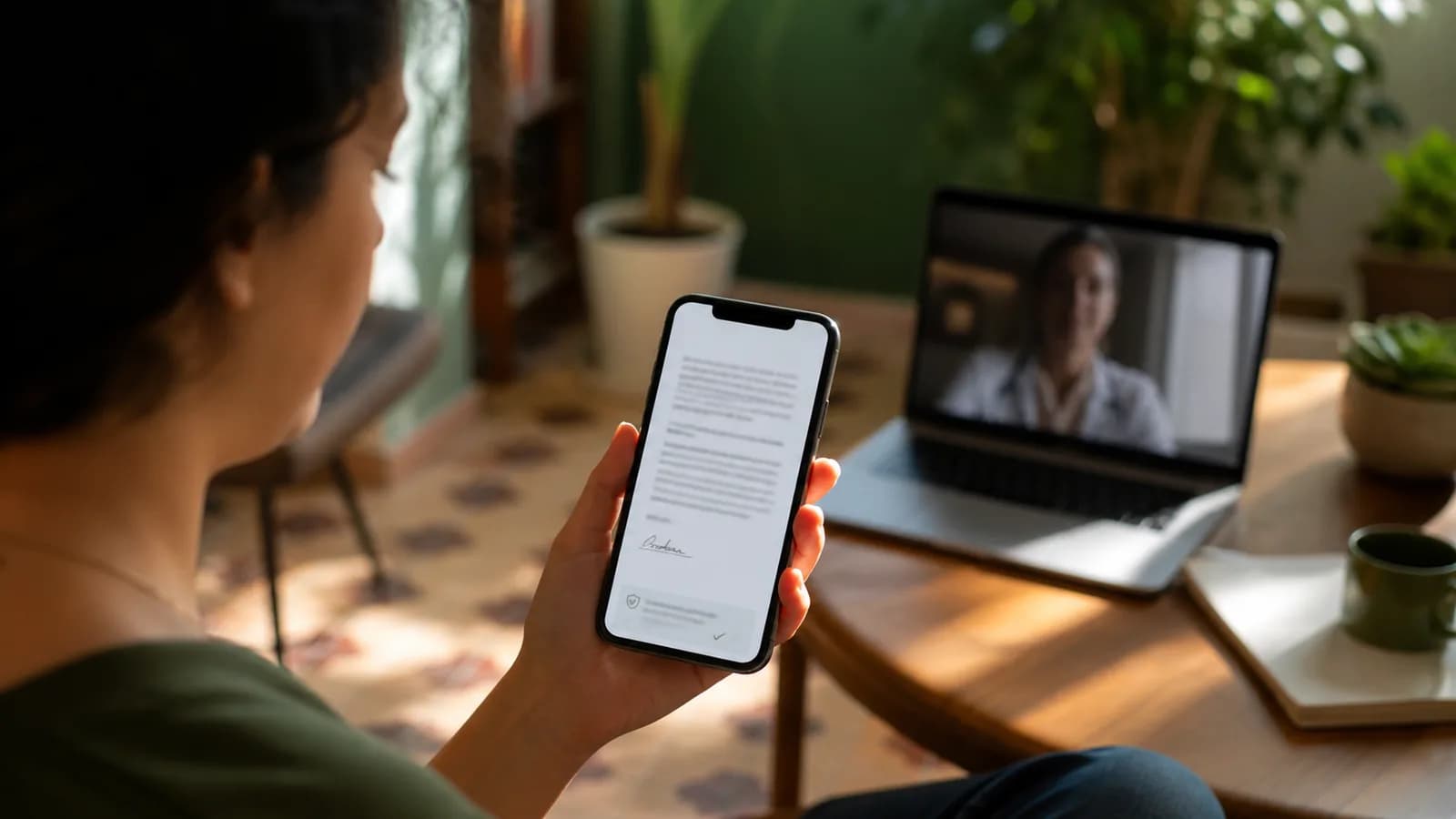

Does an Attendance Certificate Excuse an Absence? Understanding the Difference from a Medical Certificate
These are two documents with different purposes. One justifies the time you spent at the appointment; the other justifies the day you were unable to work.
The attendance certificate, also called an attendance declaration, proves that you attended an appointment, test or therapy session on a given day and shift. It does not excuse the entire day by law: according to the Tribunal Superior do Trabalho, it justifies only the time of the appointment, and the rest depends on company policy or the collective bargaining agreement. What excuses the absence is the medical certificate, which only a doctor can sign and which states that you were unfit for work, based on Lei 605/1949. The CLT guarantees specific absences, such as up to 3 days a year for cancer preventive screening.
Two documents, two purposes
Attendance certificate and medical certificate: what's the difference
The two names sound similar, but each document states something different.
- Attendance declaration (or certificate): states that you were at the location, on a given date and shift, for an appointment, test, therapy session or to accompany someone. It can be signed by a doctor, dentist, psychologist, physiotherapist or the facility's front desk.
- Medical certificate: states that you were unfit for work for a specific period. Only a doctor can sign it, and the document must include the day, the time and the required rest period.
The TST sums it up this way: both justify health-related absences, but only the medical certificate covers the entire day. The attendance certificate covers only the time you needed to be away for the appointment. The TRT da 18ª Região ruled the same way, denying validity as a medical certificate to an attendance certificate issued by a health clinic.
TST — Do you know the difference between a medical certificate and an attendance certificate? and TRT-18. Accessed September 7, 2026.
What the law guarantees
Does the attendance certificate excuse the absence?
By law, only the time of the appointment. The rest of the day depends on the company or the collective bargaining agreement.
Lei 605/1949 states that an employee's illness, proven by a certificate, is a justified and paid absence. It says nothing about attending an appointment. If you went to the doctor at 9 a.m. and returned at 11 a.m., the certificate justifies those two hours. If you stayed home the whole day with only that certificate, the company can deduct the rest, unless a collective agreement or internal policy is more favorable. Some companies excuse the whole day as a matter of their own policy; check yours. There is no legal limit on the number of certificates, as long as they are genuine and issued by a qualified professional, as the TST has already clarified.
Lei 605/1949, art. 6º, §1º, f and TST — Is there a legal limit on attendance certificates?.
CLT, art. 473
When the CLT guarantees the absence even without being ill
Three health-related situations are set out in law and don't depend on the company's goodwill. The attendance certificate is what proves each of them.
- Cancer preventive screening: up to 3 days every 12 months of work, duly proven (inciso XII, Lei 13.767/2018). Since April 2026, Lei 15.377 requires the employer to inform the employee about this option, expressly mentioning HPV and cancer screening tests.
- Accompanying a wife or partner during pregnancy: for the time needed for up to 6 medical appointments or complementary tests (inciso X, redação da Lei 14.457/2022).
- Accompanying a child up to age 6 to a medical appointment: 1 day per year (inciso XI, Lei 13.257/2016).
- Your own appointment, test or therapy, outside these situations: there is no legal guarantee of excused absence; the shift-based rule explained above applies.
In these cases, a medical certificate is not required. It is the attendance certificate, with the date, shift and purpose, that proves the reason set out in law.
Lei 13.767/2018, Lei 15.377/2026 and CLT, art. 473, incisos X e XI.
Minimum content
What the attendance certificate must include
Without these items, the company has grounds to refuse it. Check before you leave the front desk.
- The patient's full name (or the accompanied person's name, in the case of a companion).
- The date and shift of the appointment, or the arrival and departure times.
- The location of the appointment.
- Purpose: appointment, test, therapy or accompanying a patient.
- The professional's signature and identification, with a stamp or professional council registration number.
If the document is issued by a doctor, the CFM rules apply: legible details, signature and stamp or CRM number, and the time on record. The CID is only included with your express authorization (Resolução CFM 1.658/2002, art. 5º). The company can check the document's authenticity, not demand the diagnosis.
In-person or online appointment
What the doctor can write, including for an online appointment
The doctor certifies what they observed. They cannot issue a document without a medical act to justify it, and cannot refuse to certify what they did.
It's set out in the Código de Ética Médica: issuing a document without a professional act to justify it is prohibited (art. 80), and so is refusing to certify acts already performed when the patient requests it (art. 91). At the end of any appointment, you are entitled to the attendance certificate. Whether a certificate with time off is issued depends on the assessment: if the doctor determines that you are fit to work, they issue the attendance certificate, not the medical certificate. In telemedicine, the rule is the same, with one additional requirement: Resolução CFM 2.314/2022 requires the doctor's name, CRM number and address, patient identification, date, time and an ICP-Brasil digital signature. At Global Health, the online clinical appointment follows this rule: the doctor issues the attendance certificate and, when they assess incapacity, the online medical certificate with a digital signature. The appointment does not guarantee time off; the doctor decides.
Código de Ética Médica, capítulo X and Resolução CFM 2.314/2022, art. 13.
Global Health Brasil
Next steps
The doctor assesses and documents the appointment. Whether or not to excuse the absence is the company's decision, within the law and the collective bargaining agreement.
- Online medical certificate
- Online clinical appointment
- Online medical certificate: validity and rules
- Doctors in Brasil
- Talk to Global Health
Need a medical assessment with a valid document?
An appointment with a licensed doctor, an attendance certificate and, if there is incapacity, a certificate signed with an ICP-Brasil digital signature.
Official sources
Sources for this guide
Federal legislation, the Tribunal Superior do Trabalho and the Conselho Federal de Medicina, accessed on September 7, 2026.
Collective bargaining agreements and internal company policies may be more favorable than the law. Check yours.
Frequently asked questions
Questions about the attendance certificate
How many hours does the attendance certificate cover?
The time of the appointment shown on the document, usually the shift or the arrival and departure times. It does not cover the whole day, unless company policy or a collective agreement says otherwise.
Does an attendance certificate work as a medical certificate?
No. A medical certificate requires an assessment by a doctor and states incapacity for work. The attendance certificate only proves you were present at the appointment.
Can the company require the CID on the certificate?
No. Under Resolução CFM 1.658/2002, the diagnosis is only included on the document with the patient's express authorization. The company can verify the document's authenticity, not the reason.
Does an online appointment provide an attendance certificate?
Yes, with an ICP-Brasil digital signature, the doctor's name and CRM number, date and time, as required by Resolução CFM 2.314/2022. A certificate for time off depends on the clinical assessment.